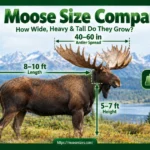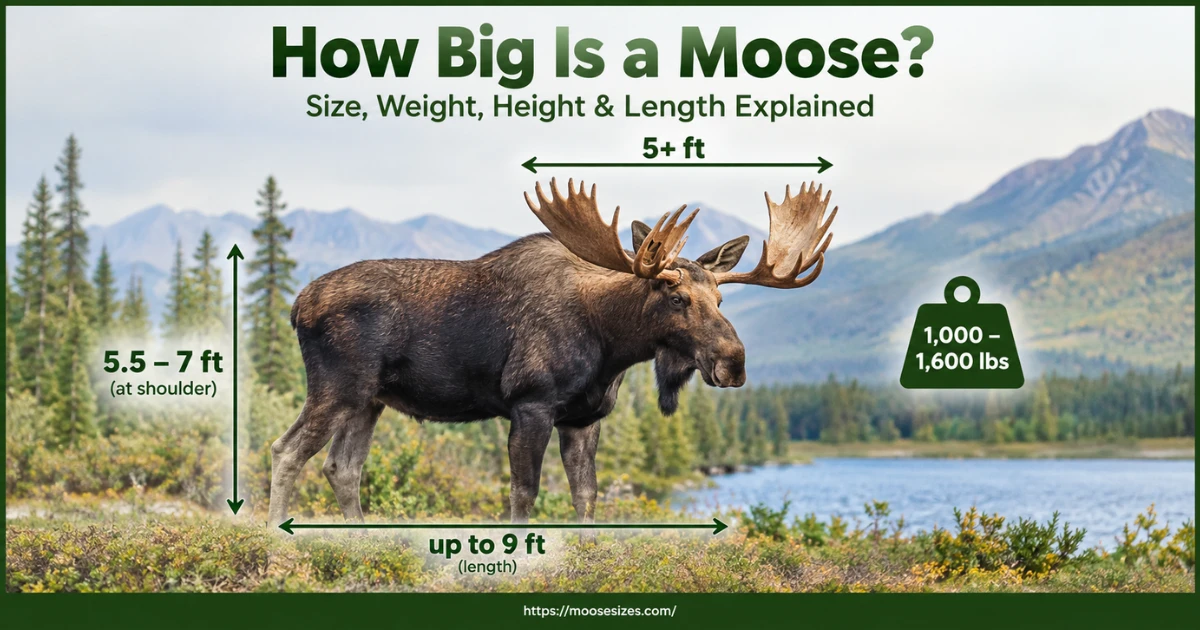
A full-grown bull moose can weigh up to 1,800 pounds and stand nearly 7 feet tall at the shoulder.
A moose is the biggest deer on Earth, and its size alone can stop hikers, drivers, and hunters in their tracks. A bull moose can weigh more than a small car and stand taller than a front door.
Weight, Height, and Length at a Glance
| Moose Type | Weight | Shoulder Height | Length |
|---|---|---|---|
| Bull (Male) Moose | 1,000–1,600 lb (454–726 kg) | 5.5–7 ft (1.7–2.1 m) | Up to 9 ft (2.7 m) |
| Cow (Female) Moose | 800–1,300 lb (363–590 kg) | 5–6 ft (1.5–1.8 m) | 7–8 ft (2.1–2.4 m) |
| Moose Calf | About 28 lb (13 kg) at birth | About 2.5–3 ft (0.8–0.9 m) | About 4–5 ft (1.2–1.5 m) |
Bull (Male) Moose Size
A full-grown bull moose typically weighs between 1,000 and 1,600 pounds, depending on subspecies and region. Bulls stand roughly 5.5 to 7 feet tall at the shoulder — not counting the head or antlers — and can measure close to 9 feet long from nose to tail.
The heaviest bulls come from Alaska, where cold climates and rich forage push body weight to the upper end of the range.
Cow (Female) Moose Size
A cow moose is smaller but still massive by deer standards. Adult females usually weigh 800 to 1,300 pounds and stand around 5 to 6 feet at the shoulder. Unlike bulls, cows never grow antlers, which is the easiest way to tell the sexes apart at a distance.
Moose Calf Size and Growth Rate
A newborn moose calf weighs only about 28 pounds at birth — roughly the size of a three-year-old child. Growth after that is fast.
Calves can gain 2 to 5 pounds a day during their first summer, fueled by rich milk and constant browsing. By five days old, a calf can already outrun an average adult human.
Moose Size by Subspecies
Alaska Moose (Alces alces gigas)
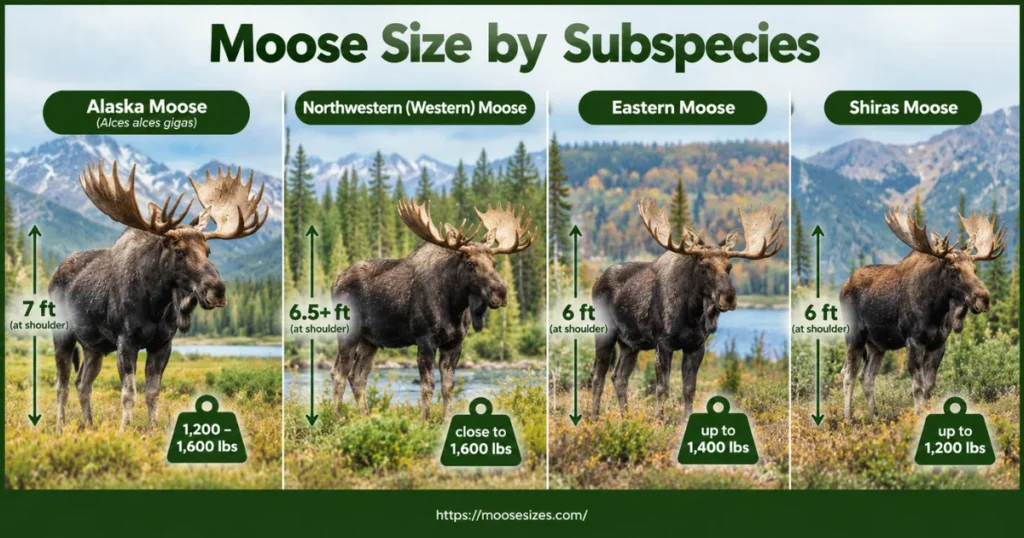
The Alaska moose, also called the Yukon moose, is the biggest moose subspecies in the world. Bulls stand close to 7 feet at the shoulder and weigh 1,200 to 1,600 pounds, with some record bulls topping 1,800 pounds.
Northwestern (Western) Moose
The Northwestern moose ranges across western Canada and parts of Minnesota, Michigan, and Wisconsin. It’s the second-largest subspecies, with bulls reaching over 6.5 feet at the shoulder and weighing close to 1,600 pounds in prime condition. These moose eat an enormous amount daily — often near 70 pounds of vegetation — to sustain that bulk.
Eastern Moose
Found across Maine, New York, New England, and eastern Canada, the Eastern moose is mid-sized. Bulls typically weigh up to 1,400 pounds and stand around 6 feet tall at the shoulder. Eastern moose populations are a major draw for hunters in the northeastern United States and Atlantic Canada.
Shiras Moose
The Shiras moose lives in the Rocky Mountains, including Colorado, Wyoming, and Idaho. It’s the smallest of the four subspecies, with bulls weighing up to 1,200 pounds and standing about 6 feet at the shoulder. Even as the “small” moose, a Shiras bull still outweighs most elk and every whitetail deer.
Moose Brain Size
How Big Is a Moose Brain?
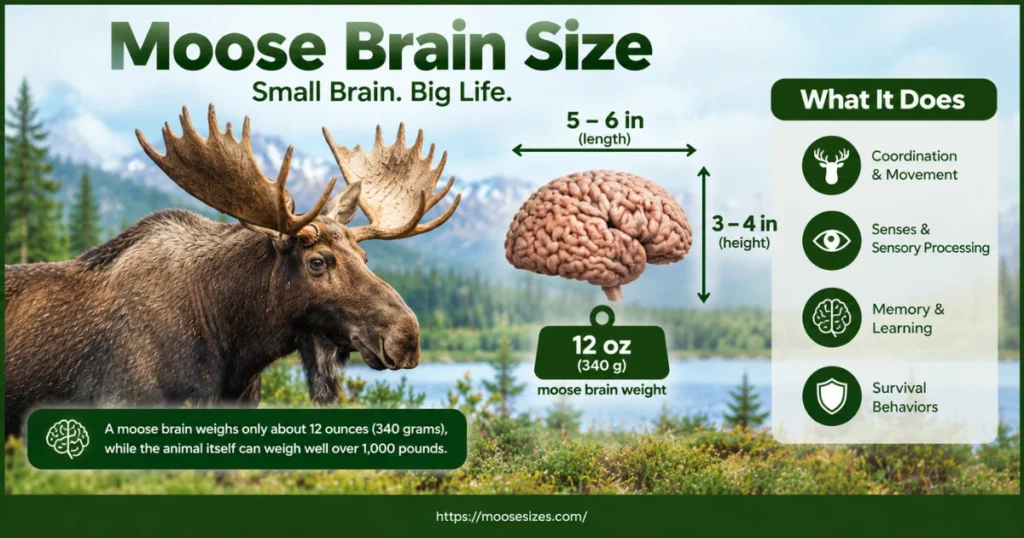
An adult moose has a relatively small brain compared with its massive body. A moose brain weighs roughly 12 ounces (340 grams), while the animal itself can weigh well over 1,000 pounds. Despite its size, the brain supports essential functions such as movement, memory, senses, and survival behaviors.
What Does a Moose Brain Do?
The moose brain controls important behaviors and body functions, including coordination, sensory processing, feeding, movement, and responses to threats. Its strong senses and ability to remember feeding areas and navigate its habitat help moose survive across forests, wetlands, and other challenging environments.
Moose Antler Size and Growth
How Wide and Heavy Are Moose Antlers?
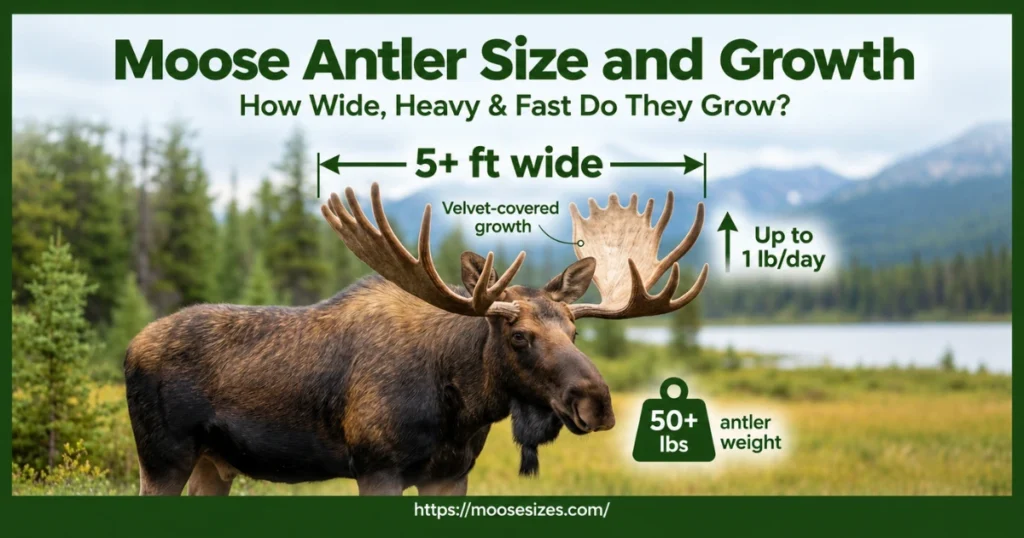
A mature bull’s antlers can spread five feet wide or more and weigh over 50 pounds. Antlers are palmate, meaning flattened like an open hand, which sets moose apart from elk and deer, whose antlers branch into narrow points.
How Fast Do Moose Antlers Grow?
Moose antlers are among the fastest-growing bone tissue in the animal kingdom. A bull can add up to a pound of antler per day, gaining as much as 80 pounds of new antler in a single summer.
Growth starts in late winter under a soft layer called velvet, which is shed by fall just before the breeding season, known as the rut.
How Big Is a Moose Compared to Other Animals?
Moose vs. Elk Size
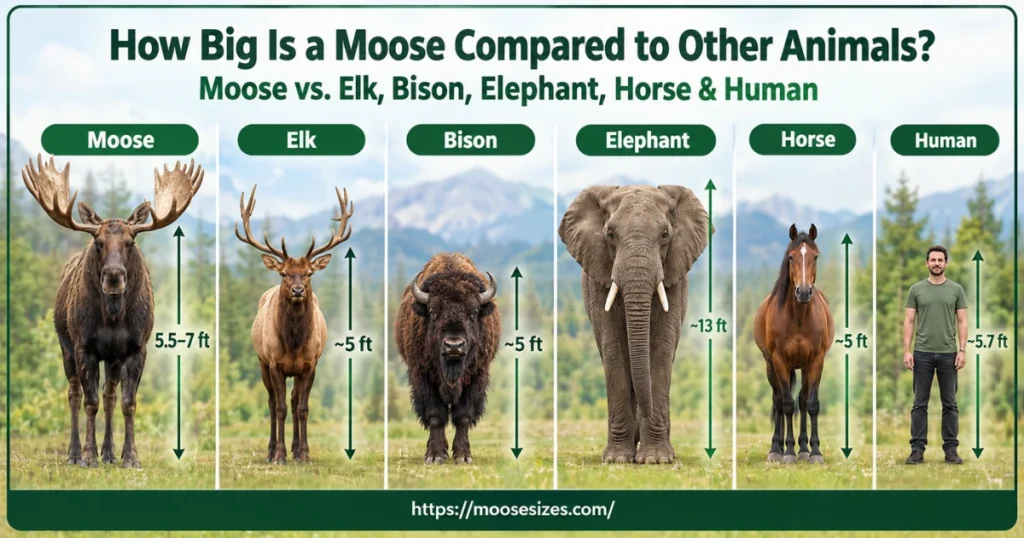
A bull moose completely outsizes a bull elk. Elk typically weigh just over 1,000 pounds and stand about 5 feet at the shoulder — that’s roughly the size of a female Alaska moose. Even a smaller Shiras bull moose outweighs a trophy bull elk.
Moose vs. Bison Size
Bison are heavier on average, reaching up to 2,000 pounds, but they don’t grow as tall. A big bull moose can match or exceed bison height at the shoulder, even though bison usually win on raw weight.
Moose vs. Elephant Size
There’s no contest here. An African elephant can weigh 5,000 to 14,000 pounds and stand up to 13 feet tall — dwarfing even the biggest Alaska moose. Moose are giants among deer, but elephants remain in a size class of their own.
Moose vs. Horse Size
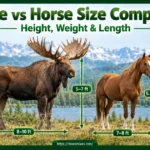
An average quarter horse weighs around 1,200 pounds, putting it in the same weight range as a bull Shiras moose. Interestingly, moose have occasionally been tamed and ridden, though this is extremely rare and not something wild moose tolerate.
Moose vs. Human Size
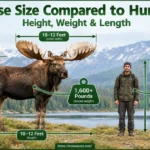
Compared to an average adult human, a bull moose is roughly a foot taller and many times heavier. The tallest moose on record stood about 7.6 feet — still short of the tallest human ever recorded, but far heavier than any person.
In terms of raw mass, a large bull moose can outweigh even the heaviest humans on record by hundreds of pounds.
What Determines How Big a Moose Gets?
Diet and Habitat Quality
Moose are browsers that rely on willow, birch, aspen, and aquatic plants. In areas with rich, abundant forage, moose grow larger and reproduce more successfully.
Poor habitat, drought, or overcrowded herds can lower body weight and even reduce pregnancy rates, which is why wildlife agencies track herd health closely.
Age, Genetics, and Subspecies
A moose keeps growing until it reaches full maturity, usually between 6 and 12 years old, which is also when antlers hit peak size. Genetics play a role too — this is why Alaska moose consistently outgrow Shiras moose even under similar conditions.
More Posts: Bull Moose Size, Weight, Height, Length & Comparisons
FAQ’s About How Big Is a Moose
How big is a full-grown moose?
A full-grown bull moose weighs 1,000 to 1,600 pounds and stands 5.5 to 7 feet tall at the shoulder, depending on subspecies.
How tall is a moose at the shoulder?
Most adult moose stand 5 to 7 feet tall at the shoulder, with Alaska moose reaching the top of that range.
What is the biggest moose ever recorded?
The largest recorded moose weighed 1,808 pounds and stood 7.6 feet tall, taken in Alaska in 1897.
How much do moose calves weigh at birth?
A newborn moose calf weighs about 28 pounds, roughly the size of a three-year-old child.
Are moose bigger than elk?
Yes. A bull moose is significantly bigger than a bull elk in both height and weight, and even smaller moose subspecies outweigh most elk.

Hi, I’m Natalie Collins, the admin at MooseSizes.com. We simplify animal sizes, measurements, and wildlife comparisons with easy-to-follow guides, useful size charts, and accurate information to help you understand animal dimensions with confidence.