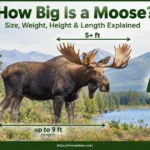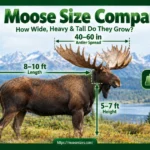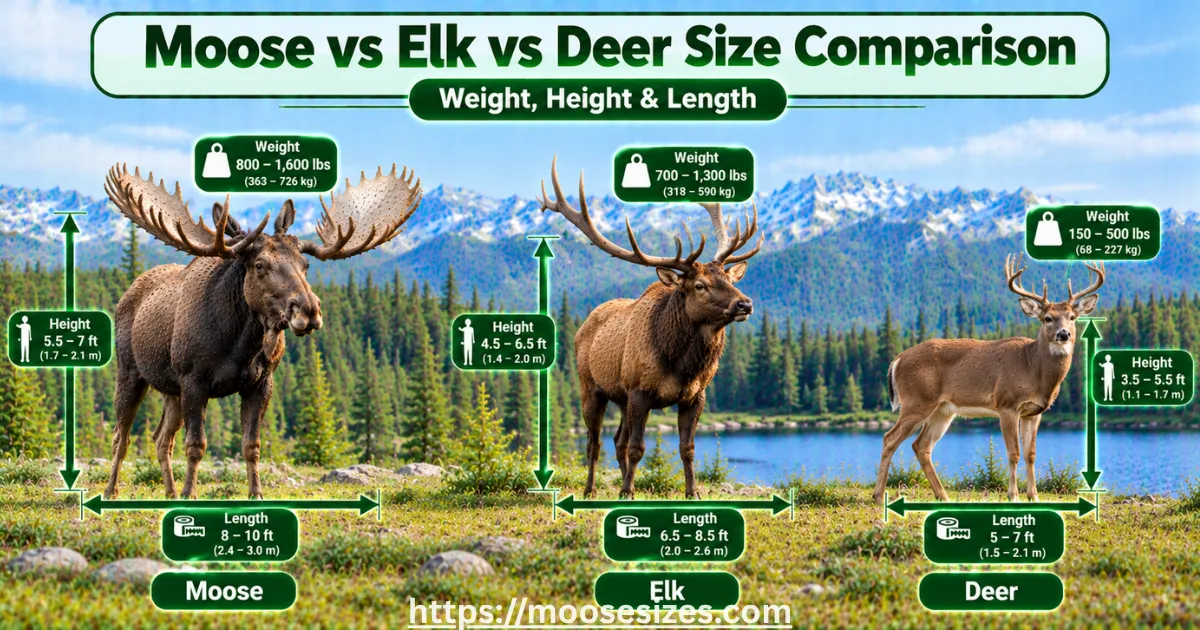
A full-grown moose can weigh 800–1,400 pounds and stand 5.5–6.5 feet tall at the shoulder.
An elk typically weighs 500–700 pounds and stands 4–5 feet tall.
A white-tailed deer weighs 100–300 pounds and stands 2.5–3.5 feet tall at the shoulder.
Moose are the biggest of the three, followed by elk, then deer. A bull moose can weigh three times more than a whitetail buck and stand nearly two feet taller at the shoulder.
More Posts: Moose vs Camel Size
Moose vs Elk vs Deer Size at a Glance
| Animal | Weight (Bulls/Bucks) | Height at Shoulder |
|---|---|---|
| Moose | 1,200–1,600 lbs | 5.5–6.5 ft |
| Elk | 700–1,100 lbs | 4–5 ft |
| Deer | 100–300 lbs | 2.5–3.5 ft |
Which Is Bigger — Moose, Elk, or Deer?
Moose win on every measure. A big bull moose can outweigh an elk by 500 pounds and a deer by over 1,000 pounds. Elk sit in the middle — noticeably bigger than deer but only about two-thirds the size of a moose.
Moose vs Elk vs Deer Weight Comparison
Moose Weight (Bulls vs Cows)
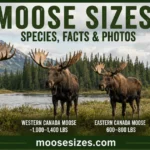
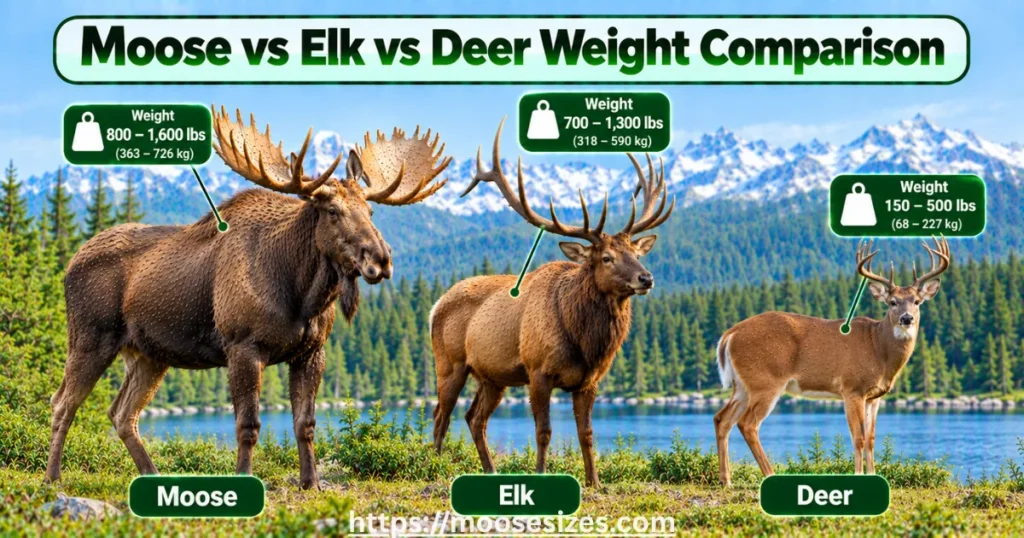
Bull moose typically weigh 1,200 to 1,600 pounds, with some Alaska-Yukon bulls topping 1,800 pounds. Cow moose run smaller, usually 800 to 1,300 pounds. That weight comes from a barrel-shaped body built for wading through deep snow and water.
Elk Weight (Bulls vs Cows)
Bull elk average 700 to 1,100 pounds. Cow elk are lighter, usually 500 to 600 pounds. Elk pack muscle for the fall rut, when bulls fight for herd dominance.
Deer Weight (Bucks vs Does)
White-tailed bucks weigh 150 to 300 pounds, and mule deer bucks fall in a similar range. Does are smaller, often 100 to 150 pounds. Deer stay lean and quick, built for short bursts of speed rather than bulk.
More Posts: Moose vs Kudu Size
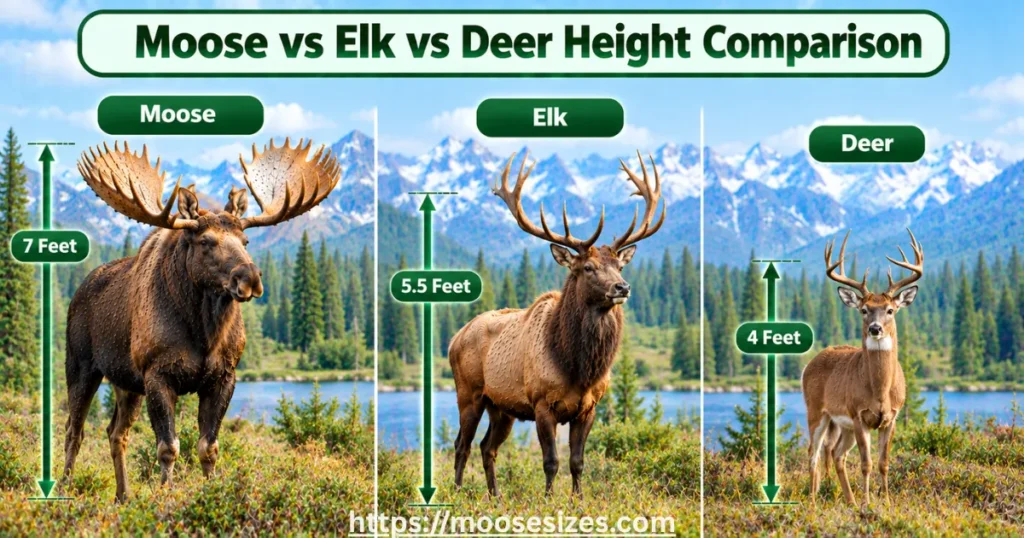
Moose vs Elk vs Deer Height Comparison
Moose Height
Moose stand 5.5 to 6.5 feet at the shoulder, with some bulls reaching 7 feet. That’s tall enough to look a person in the eye without lowering their head.
Elk Height
Elk stand 4 to 5 feet at the shoulder. A bull elk’s head and antlers can push its total height well past that when it’s alert.
Deer Height
Deer stand just 2.5 to 3.5 feet at the shoulder. That’s roughly waist-height on an adult, which is why deer are the easiest of the three to mistake for a large dog at a distance.
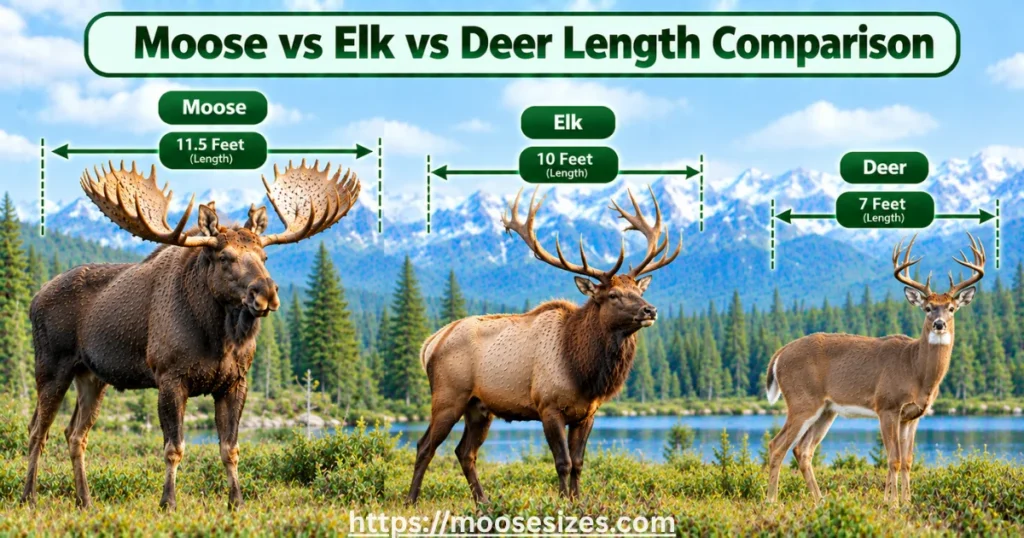
Moose vs Elk vs Deer Length Comparison
Moose Length
Bull moose measure 7.5 to 10 feet long, with an average around 8.5 feet — close to the size of a small car. Cow moose run slightly shorter, typically 6.5 to 9.5 feet.
Elk Length
Bull elk stretch 6.5 to 8 feet long. Cow elk are a bit shorter, usually 6.5 to 7.5 feet. Despite the gap in weight, elk length can come surprisingly close to a moose’s.
Deer Length
Whitetail and mule deer measure 4.5 to 7 feet long, the shortest of the three by a wide margin. Their compact frame is built for quick turns and bursts of speed, not bulk.
More Posts: Moose vs Bear Size
Moose vs Elk vs Deer Antler Size Comparison
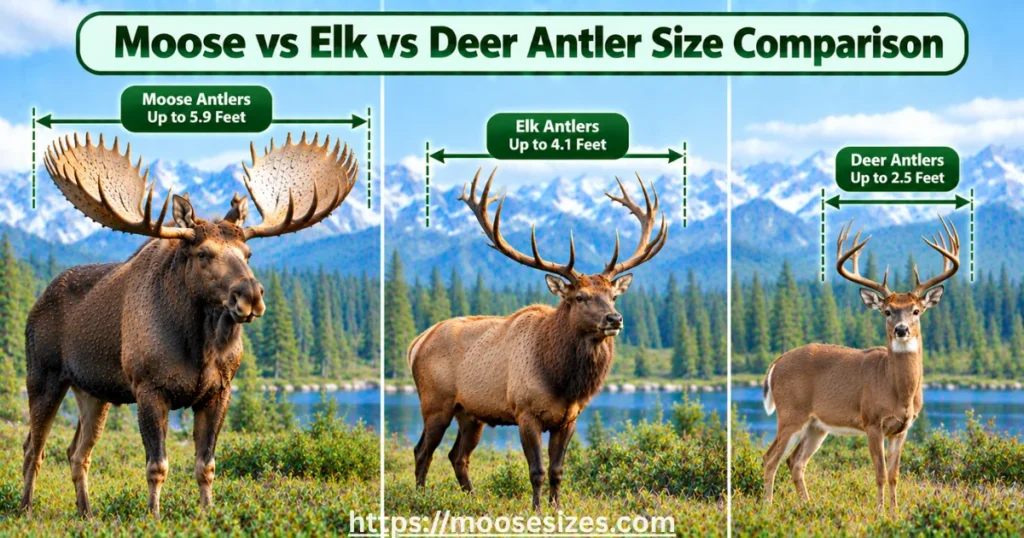
Antlers are the fastest way to identify each animal, even without a weight or height estimate.
Moose Antler Size (Palmate Spread)
Moose grow palmate antlers — broad, flat, paddle-shaped racks that can span up to 6 feet across. A mature set can weigh 40 pounds or more, making them the heaviest antlers of the three.
Elk Antler Size (Beam Length)
Elk antlers grow as long, sweeping main beams with points branching off, reaching up to 4 feet long. They’re built for locking with rival bulls during the rut, not for width.
Deer Antler Size (Point Spread)
Deer antlers are the smallest and most compact, usually spanning 15 to 25 inches tip to tip. They branch into a handful of points rather than forming a broad shape like moose or elk antlers.
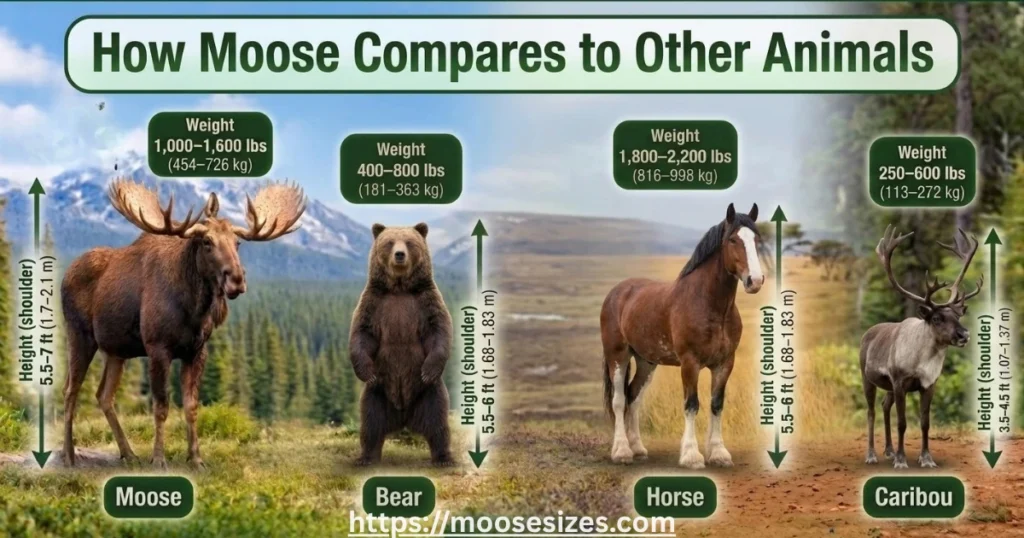
Moose Compares to Other Animals
Moose vs Horse Size
An average riding horse stands 5 to 5.5 feet at the shoulder and weighs 900 to 1,200 pounds. A bull moose is taller and can weigh hundreds of pounds more, rivaling even large draft horse breeds.
Moose vs Bear Size
A grizzly bear weighs 400 to 800 pounds, far less than a bull moose. But on hind legs, a grizzly can reach 8 feet tall, taller than a moose standing normally.
Moose vs Caribou Size
Caribou weigh 240 to 700 pounds and stand about 4 feet at the shoulder. A moose dwarfs a caribou in both height and weight, often by double or more.
More Posts: Moose vs Clydesdale Size
FAQ’s About Moose, Elk and Deer Size
Is a moose bigger than an elk?
Yes. A bull moose can weigh up to 1,600 pounds and stand over 6 feet tall, while a bull elk tops out around 1,100 pounds and 5 feet tall.
What is the biggest of the three — moose, elk, or deer?
The moose is the biggest by far, followed by elk, then deer, which is the smallest of the three.
How much taller is a moose than a deer?
A moose can stand 3 feet taller than a deer at the shoulder, since moose reach 6.5 feet while deer top out around 3.5 feet.
How much does a moose weigh compared to an elk?
A bull moose can weigh up to 1,600 pounds, while a bull elk typically weighs around 500–1,100 pounds, making moose significantly heavier.
Are moose, elk, and deer the same species?
No. Moose, elk, and deer belong to the deer family (Cervidae), but they are different species with distinct body sizes, antlers, and physical characteristics.

Hi, I’m Natalie Collins, the admin at MooseSizes.com. We simplify animal sizes, measurements, and wildlife comparisons with easy-to-follow guides, useful size charts, and accurate information to help you understand animal dimensions with confidence.