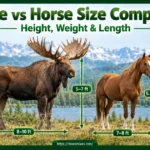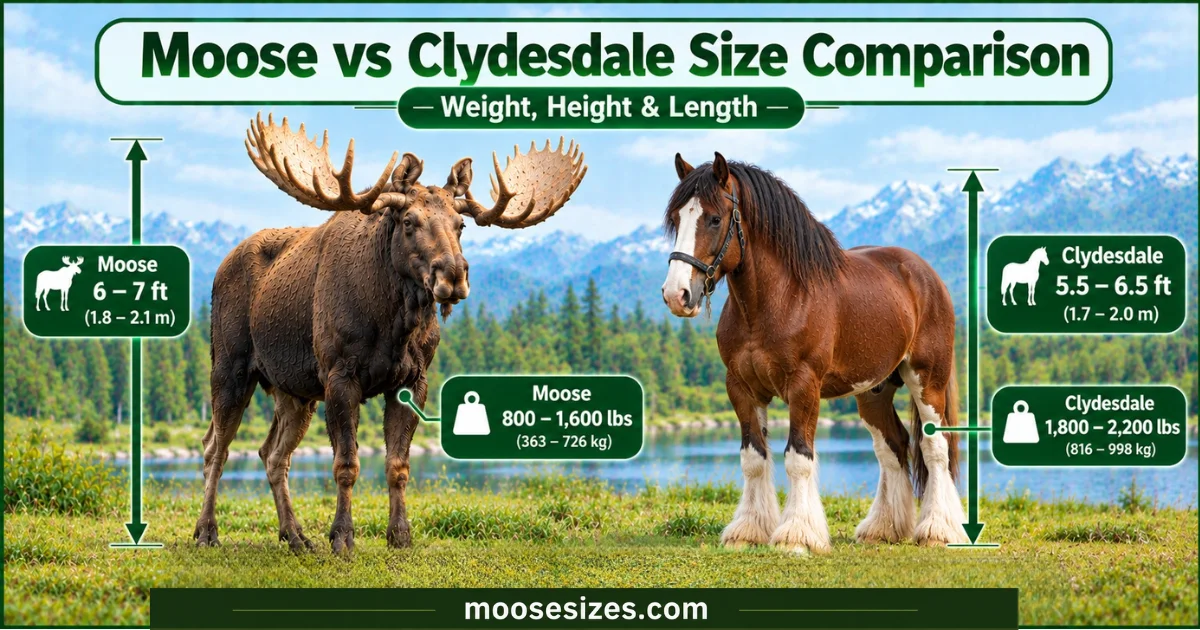
A moose has an average shoulder height of 5.5–6.5 feet and weighs around 800–1,400 pounds. A horse typically stands 5.3–6 feet (16–18 hands) tall at the shoulder and weighs about 1,800–2,200 pounds.
When it comes to sheer size, the moose and the Clydesdale horse are two of North America’s biggest land animals. Both are tall, heavy, and impressive to stand next to. But which one actually wins in a moose vs Clydesdale size showdown?
Moose vs Clydesdale Size Comparison Chart
| Feature | Moose | Clydesdale |
|---|---|---|
| Average height (shoulder) | 5.5–6.5 ft | 5.3–6 ft (16–18 hands) |
| Average weight | 800–1,400 lbs | 1,800–2,200 lbs |
| Body length | 8–10 ft | 7–8 ft |
| Tallest recorded | ~7.5 ft | ~6.5 ft |
Moose vs Clydesdale Size at a Glance
At a glance, the moose usually stands taller, while the Clydesdale carries far more bulk. Height goes to the moose. Weight goes to the horse. That trade-off shapes the entire comparison.
More Posts: Moose vs Bison Size, Weight, Height & Length
Moose vs Clydesdale Height Comparison
How Tall Is a Moose at the Shoulder
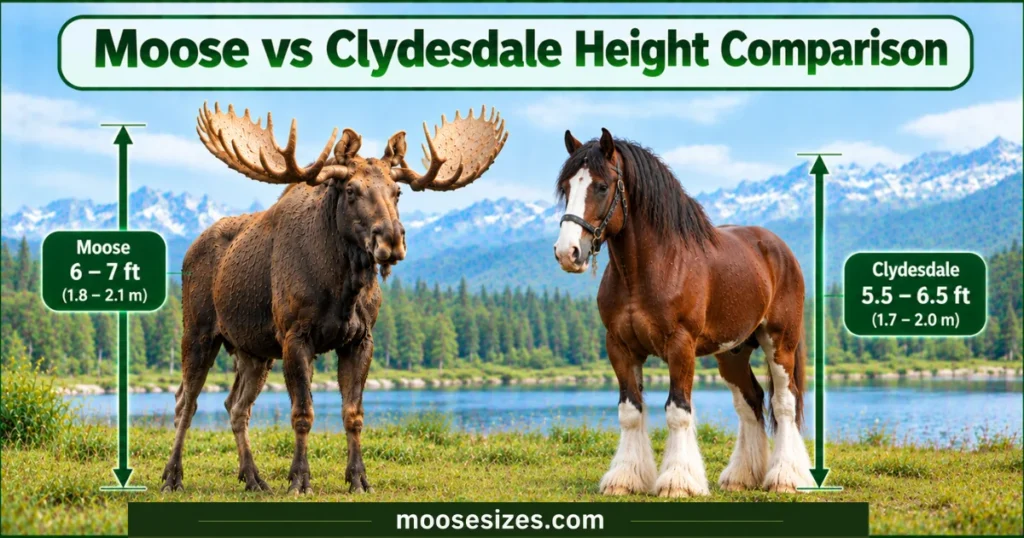
A mature bull moose stands about 5.5 to 6.5 feet tall at the shoulder. The biggest bulls, especially in Alaska and Canada, can reach nearly 7.5 feet. That height comes from long legs built for wading through deep snow and swampy terrain.
How Tall Is a Clydesdale Horse
A Clydesdale typically stands 16 to 18 hands, which works out to roughly 5.3 to 6 feet at the withers. That’s already taller than most horse breeds, which is exactly why Clydesdales feel so massive up close.
Moose vs Clydesdale Height With Antlers Included
Here’s a detail most comparisons skip: a bull moose’s antlers can span 4 to 6 feet wide and add real height when the head is raised. Factor that in, and a standing moose can visually tower well beyond 7 feet — something no Clydesdale can match, since horses don’t carry antlers at all.
More Posts: Moose vs Elephant Size, Weight, Height, Length & Chart
Moose vs Clydesdale Weight Comparison
Average Moose Weight
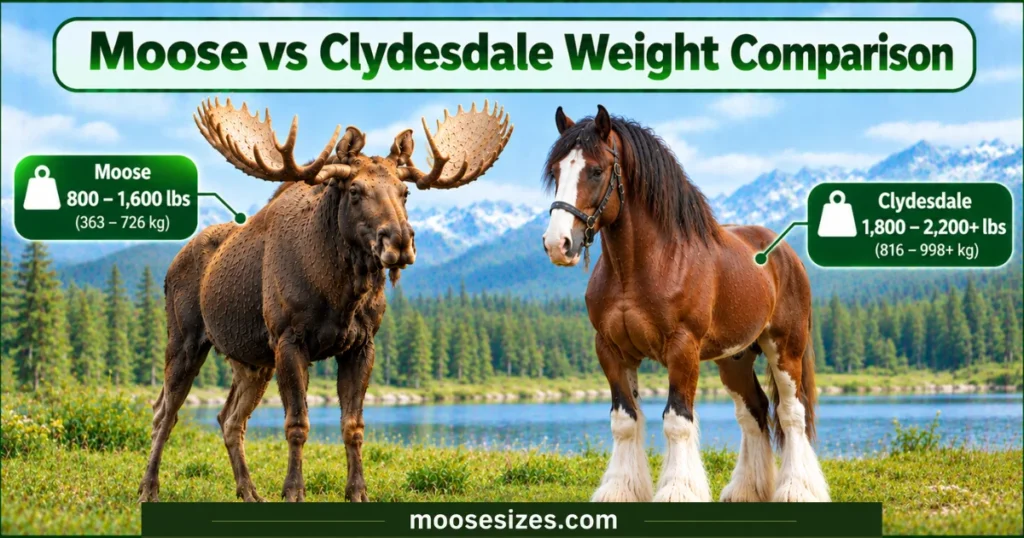
Bull moose average 800 to 1,400 pounds, with the largest bulls pushing close to 1,500 pounds. Cows (females) are noticeably smaller, usually weighing 800 to 1,200 pounds.
Average Clydesdale Weight
A full-grown Clydesdale typically weighs 1,800 to 2,200 pounds. That’s several hundred pounds heavier than even the biggest bull moose. Stallions tend to sit at the top of that range, built with a broad chest and thick bone structure for pulling heavy loads.
Heaviest Moose vs Heaviest Clydesdale on Record
The heaviest moose on record tips the scale around 1,800 pounds, an extreme outlier. Record-setting Clydesdales, meanwhile, have reached over 2,400 pounds. On raw weight, the Clydesdale wins outright, even against the biggest moose ever documented.
Moose vs Clydesdale Body Length and Frame
Moose Body Length and Frame
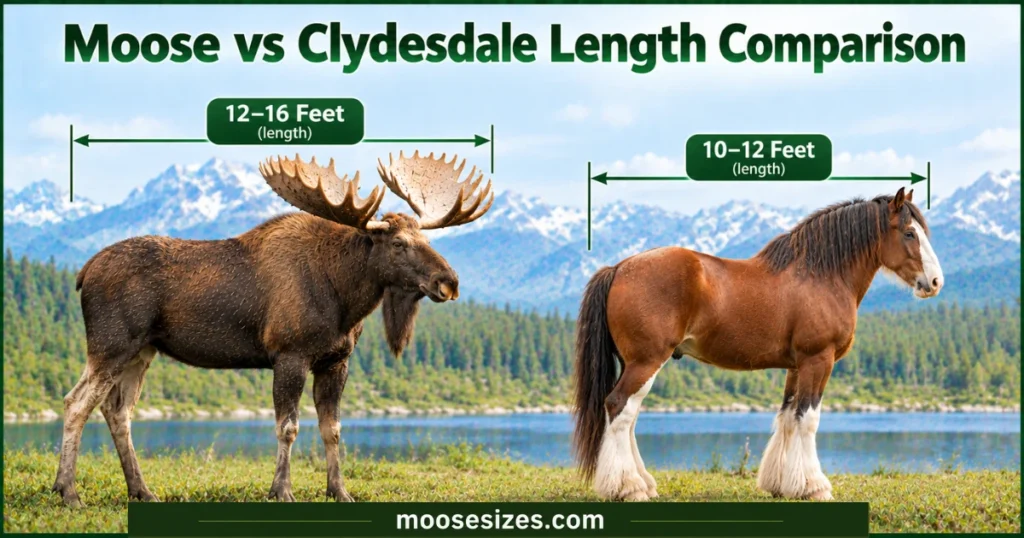
A moose measures roughly 8 to 10 feet from nose to tail. Their frame is narrow but tall, with long legs and a short torso. This build favors speed and mobility through forests and wetlands, not bulk.
Clydesdale Body Length and Frame
A Clydesdale’s body runs about 7 to 8 feet long, shorter than a moose overall. But its frame is wide and dense, built for pulling power, not distance travel. The chest alone can be nearly twice as broad as a moose’s.
Why Build Differences Affect Perceived Size
A moose looks tall and lanky. A Clydesdale looks wide and thick. Stand them side by side, and the moose often appears bigger simply because of height, even though the Clydesdale carries more actual mass. This is the core reason the “who’s bigger” question doesn’t have one simple answer.
More Posts: Moose Size vs Giant Eland Size, Weight, Height & Length
Moose vs Clydesdale — Which Is Actually Bigger?
Winner by Height
The moose takes this category, standing taller on average and even more so once antlers are factored in.
Winner by Weight
The Clydesdale wins here, outweighing even the largest bull moose by several hundred pounds.
Moose Size Compared to Other Animals
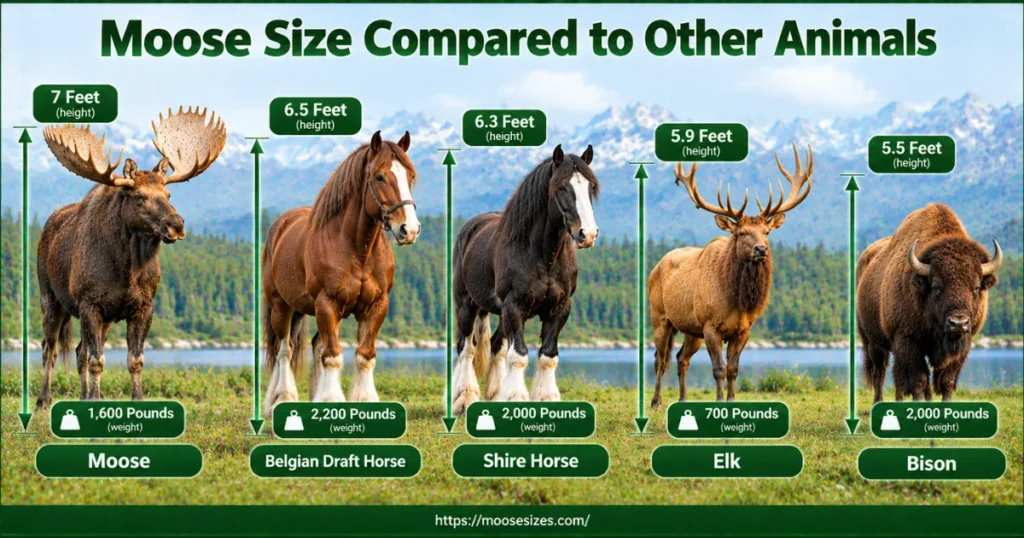
Moose vs Belgian Draft Horse
The Belgian draft horse is heavier than a Clydesdale, often weighing 1,800 to 2,200 pounds or more. Like the Clydesdale, it outweighs a moose but stands slightly shorter at the shoulder.
Moose vs Shire Horse
The Shire horse is one of the few animals that beats a moose in both height and weight. Some Shires have topped 3,000 pounds, making them the heavyweight champion of this comparison.
Moose vs Elk
Elk are in the same deer family as moose but are noticeably smaller, usually weighing 500 to 700 pounds. A moose easily outsizes an elk in both height and bulk.
Moose vs Bison
The American bison is actually the largest land animal in North America, with bulls weighing up to 2,000 pounds. Bison beat moose on weight but stand shorter, usually around 5 to 6 feet at the shoulder.
FAQ’s About Moose vs Clydesdale
Is a moose bigger than a Clydesdale horse?
It depends on the measurement. A moose is usually taller, while a Clydesdale is usually heavier.
How much taller is a moose than a Clydesdale?
A moose can stand up to 1 to 1.5 feet taller than a Clydesdale, especially when antlers are included.
How much does a Clydesdale outweigh a moose?
A Clydesdale can outweigh a bull moose by 400 to 800 pounds on average.
What is the tallest animal between a moose and a Clydesdale?
The moose is generally the taller of the two, thanks to its long legs and tall antlers.
Can a moose fight a Clydesdale?
This isn’t well documented, but the moose’s height and antlers, combined with the Clydesdale’s weight and strength, would make any encounter dangerous for both animals.

Hi, I’m Natalie Collins, the admin at MooseSizes.com. We simplify animal sizes, measurements, and wildlife comparisons with easy-to-follow guides, useful size charts, and accurate information to help you understand animal dimensions with confidence.