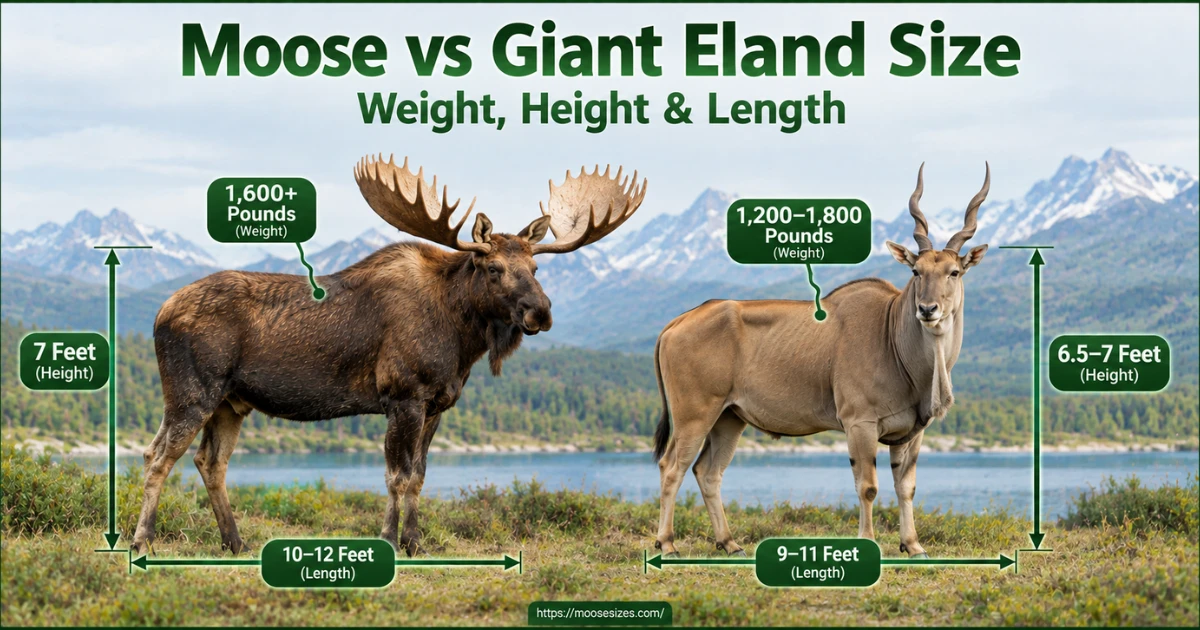
The moose usually wins in raw weight and height, but the giant eland is more muscular pound for pound.
Both animals look like they belong in a different world — huge, heavy, and hard to miss. But when you put moose size vs giant eland side by side, the numbers tell a more interesting story than “bigger wins.”
Moose Size vs Giant Eland — Quick Comparison
Moose Size (Weight, Shoulder Height, Length)
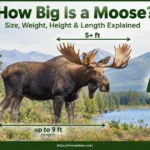
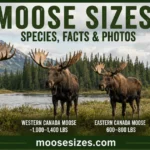
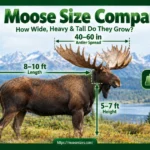
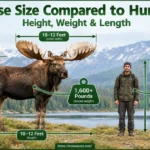
The Alaska moose, the largest moose subspecies, stands about 6.9 feet (2.1 meters) at the shoulder. Bulls typically weigh 1,400 pounds (635 kg), with the heaviest recorded bull hitting 1,808 pounds (820 kg). Cows are smaller, averaging around 1,054 pounds (478 kg).
Moose calves grow fast. A newborn weighs about 28 pounds, but by five months old, it can already reach 280 pounds. That’s a rare growth rate among land mammals.
Giant Eland Size (Weight, Shoulder Height, Length)
The giant eland, also called the Lord Derby’s eland, stands 4.2 to 5.9 feet (1.28 to 1.81 meters) at the shoulder. Bulls weigh between 880 and 2,650 pounds (400 to 1,200 kg), though most mature bulls fall closer to the 1,300–1,750 pound range in the wild.
Body length runs 7.2 to 9.5 feet, nose to tail. That’s a long, thick-bodied antelope — not a lightweight by any measure.
Giant Eland vs Common Eland
The giant eland is not always bigger than the common eland. Field guides note that Derby eland bulls earn the “giant” name mostly from their larger, more diverging horns, not extra body mass. Some common eland bulls actually outweigh giant eland bulls in the wild.
So when people search moose size vs giant eland, they’re often really comparing moose against the common eland, since that’s the antelope more frequently cited as “moose-sized.”
More Posts: Moose vs Horse Size, Height, Weight & Length
Moose vs Giant Eland Body Build and Robustness
Muscle Mass, BMI, and Length-to-Weight Ratio
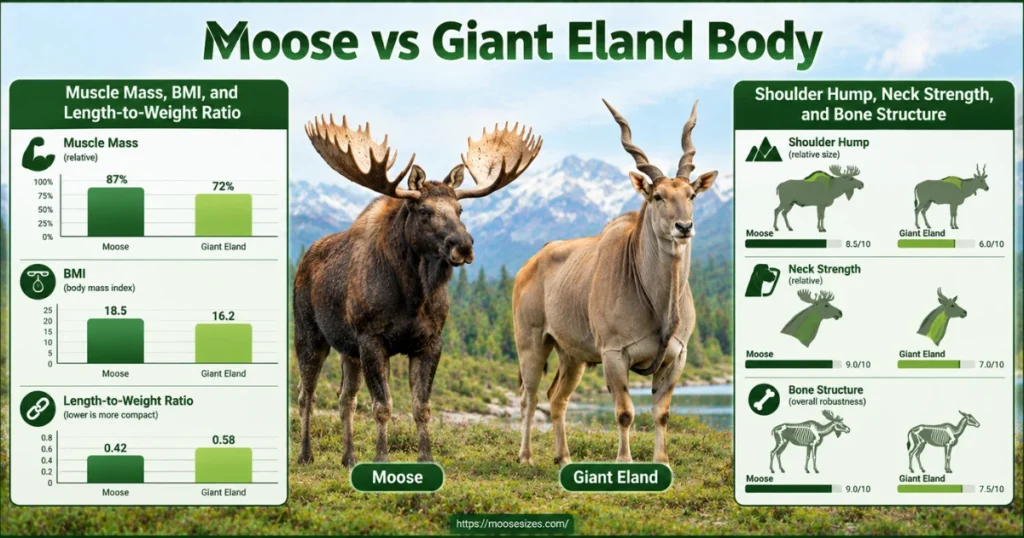
Using body mass index and length-to-weight comparisons, both giant and common eland measure roughly 6% to 16% more robust than the moose, depending on the weight range used.
A lower length-to-weight ratio means a stockier, denser frame — and the eland scores lower here than the moose. In plain terms: the eland packs more mass into a shorter frame. The moose is taller and longer, but leaner for its size.
Shoulder Hump, Neck Strength, and Bone Structure
The moose carries a large shoulder hump, similar in function to a bear’s — it’s mostly dense muscle supporting the neck and head. This gives the moose strong leverage for swinging its antlers during fights.
The eland lacks that hump but carries thick muscling through its chest and forequarters, built for sustained movement across open terrain rather than close combat.
More Posts: Moose Size Compared to Humans Height, Weight & Length
Moose Antlers vs Giant Eland Horns
Moose Antler Size and Purpose
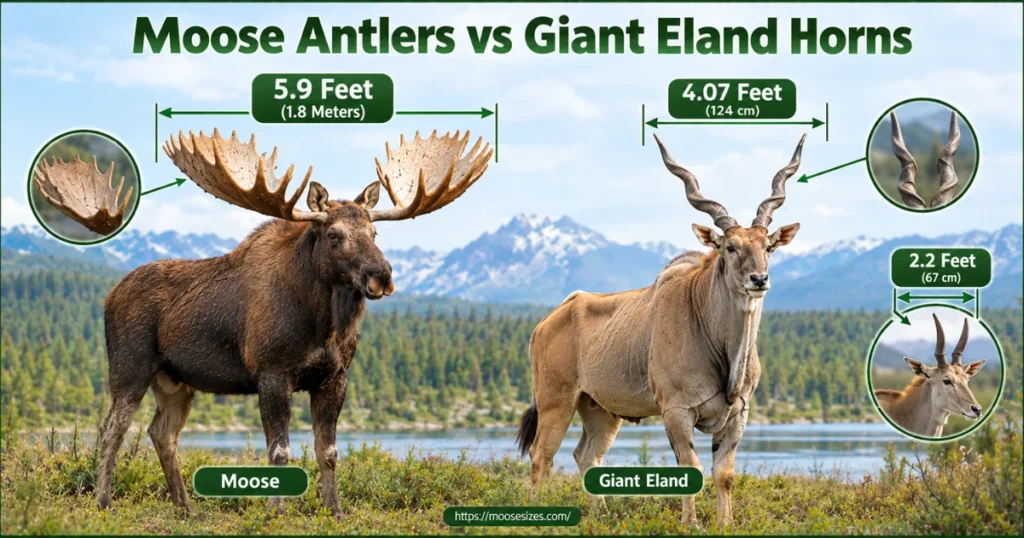
Bull moose grow palmate antlers spanning up to 5.9 feet (1.8 meters). These aren’t just decorations — they establish social rank and directly affect mating success. Antler size depends on genetics, nutrition, and age, and only males grow them.
Giant Eland Horn Size and Purpose
Both male and female giant eland grow spiraled, V-shaped horns. On bulls, horns reach up to 4.07 feet (124 cm); on cows, up to 2.2 feet (67 cm). Unlike moose antlers, eland horns are permanent — they don’t shed and regrow each year.
Which Weapon Wins in a Head-to-Head Clash
Antler shape matters here. Moose antlers are wide and flat, giving strong leverage in a shoving match. Eland horns are narrow and pointed, better suited for quick, targeted strikes than prolonged pushing contests.
More Posts: Bull Moose Size, Weight, Height & Length
Moose and Giant Eland Habitat and Survival
Where Moose Live vs Where Giant Eland Live
Moose inhabit boreal forests and wetlands across Alaska, Canada, and parts of the northern U.S. Giant eland live in open-forest and savanna regions of West and Central Africa, including Senegal, Cameroon, and South Sudan.
How Body Size Helps Each Species Survive
The moose’s bulk and long legs help it wade through deep snow and swamps. The eland’s build supports long-distance movement across dry terrain — it’s a water-independent species, able to survive on moisture pulled from plants alone.
Moose vs Giant Eland Toughness
Moose Toughness
Moose are often described by hunters as relatively “soft” for their size. A well-placed shot from a .30-06 with a 180-grain bonded bullet is widely reported as sufficient, and many hunters report one-shot kills.
Giant Eland Toughness
Eland has a reputation for soaking up hits. Hunters frequently recommend stepping up to a .300 Winchester Magnum or larger, paired with heavy, well-constructed bullets like the North Fork or Swift A-Frame, due to shot placement being further forward on African game.
Real Field Accounts on Size vs Resilience
One experienced hunter who has taken both animals multiple times summed it up simply: moose commonly stand and let a follow-up shot happen, while eland and elk rarely do — they tend to drop or run once solidly hit. This matches the size-and-toughness pattern seen across the broader hunting community.
Moose Size Compared to Other Large Animals
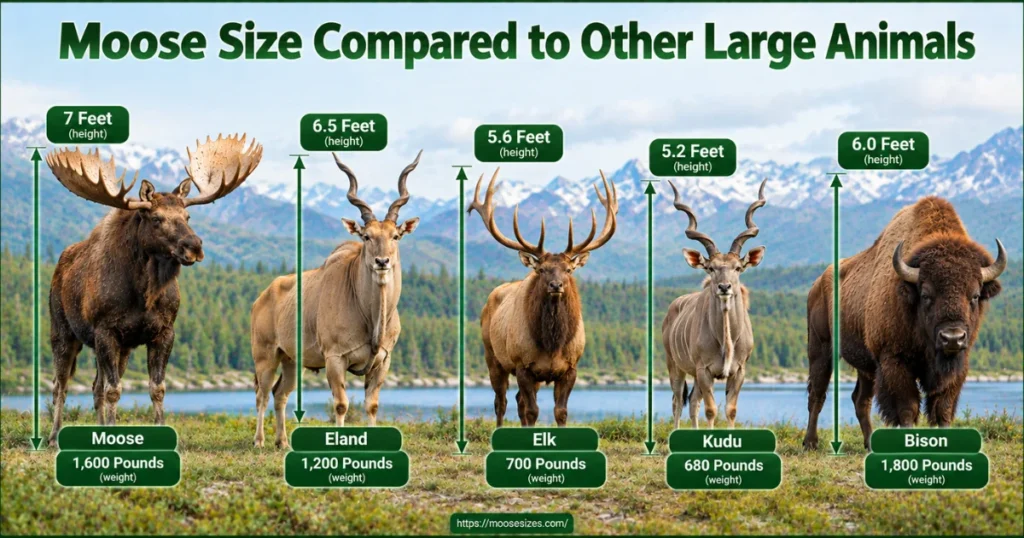
Moose vs Common Eland
At similar weights, this matchup is close to even, with the moose holding a slight edge due to superior antler leverage. The common eland can rival or exceed moose weight in exceptional bulls, sometimes topping 2,000 pounds.
Moose vs Elk
The moose is significantly larger than the elk in both height and weight. Elk bulls average 700 to 1,100 pounds, well below a mature Alaska moose bull.
Moose vs Kudu
There’s no real contest in size here. The greater kudu is tall but narrow-bodied, typically weighing 420 to 690 pounds — less than half the weight of a large bull moose.
Moose vs Bison
The American bison actually outweighs the moose, with large bulls reaching 2,000 pounds or more. Bison also carry a much wider, denser frame built for pushing power, not height.
More Posts: Shiras Moose Size, Weight, Height & Antlers
FAQ’s About Moose Size vs Giant Eland
Is a moose bigger than a giant eland?
Yes, in most cases. The moose is generally taller and heavier on average, though large eland bulls can come close.
What is the biggest antelope in the world?
The giant eland holds that title, though the common eland comes close in weight and sometimes exceeds it.
Can a giant eland beat a moose in a fight?
At equal weight, it’s close. The moose likely holds a slight edge thanks to its antler leverage and shoulder muscle.
Why is the eland compared to a moose?
Because of sheer body mass. Both animals are exceptionally large for their family — moose among deer, eland among antelope.
Do giant eland and common eland differ in size?
Slightly. The giant eland has larger horns, but the common eland often matches or exceeds it in body weight.

Hi, I’m Natalie Collins, the admin at MooseSizes.com. We simplify animal sizes, measurements, and wildlife comparisons with easy-to-follow guides, useful size charts, and accurate information to help you understand animal dimensions with confidence.