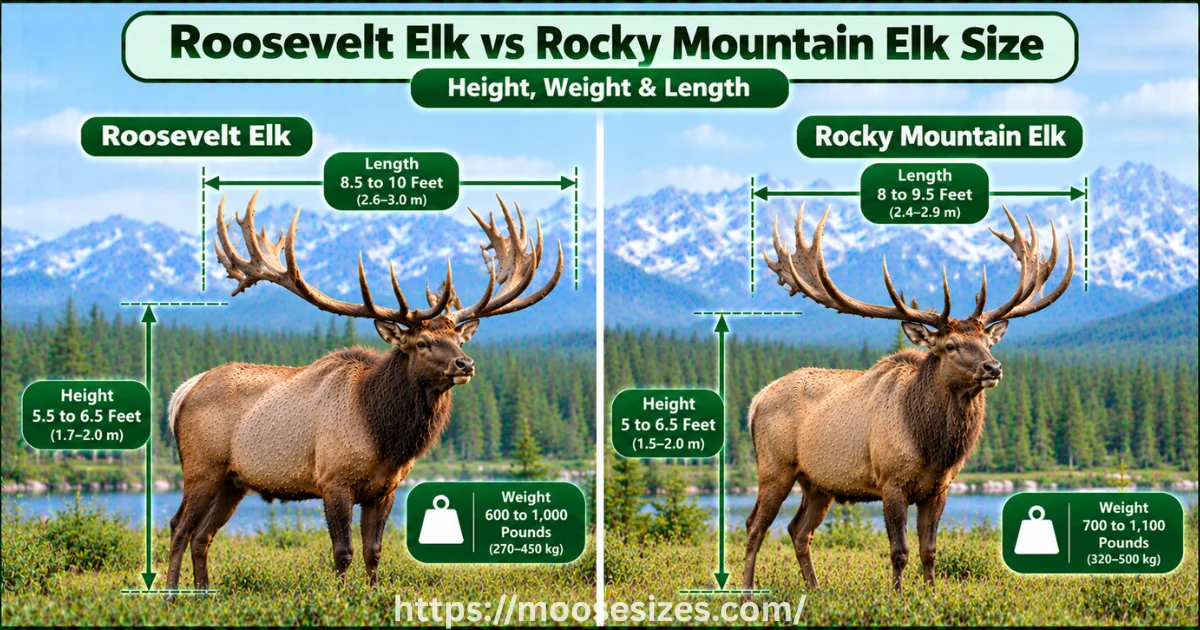
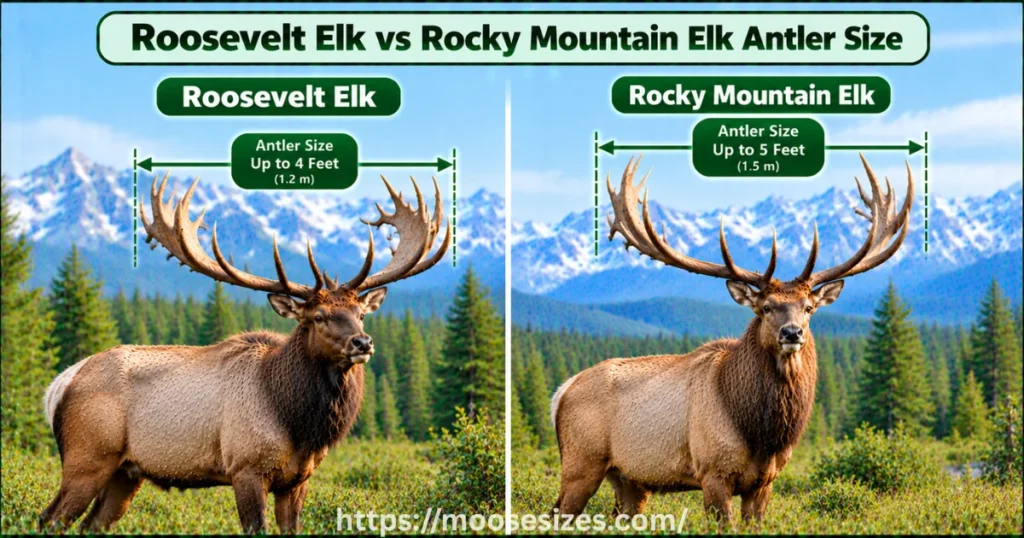
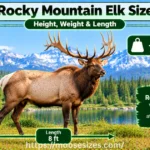
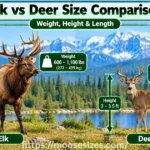
Roosevelt elk are bigger than Rocky Mountain elk in body size. A Roosevelt bull often weighs 900 to 1,100 pounds. A Rocky Mountain bull averages about 700 pounds. Rocky Mountain elk grow the longer antlers, while Roosevelt antlers are shorter and heavier.
This guide breaks down the size difference in weight, height, length and antlers. It also shows how both elk stack up against a moose.
Roosevelt vs Rocky Mountain Elk Size Chart
Measure
Roosevelt Elk
Rocky Mountain Elk
Bull weight
900 to 1,100 lb
About 700 lb
Cow weight
About 600 lb
About 500 lb
Bull shoulder height
About 5 ft
About 5 ft
Bull body length
About 8 ft
About 8 ft
Antlers
Shorter, thicker
Longer, wider
Which Elk Is Bigger
The Roosevelt elk is the largest of all North American elk subspecies by body size. It is heavier and thicker through the chest and hindquarters.
The Rocky Mountain elk is the most common and widespread. It wins only on antler length.
Picture two bulls at the peak of the rut. The Roosevelt bull steps out of the coastal timber. He can tip the scales at over 1,000 pounds. Next to him, a Rocky Mountain bull looks lean at around 700 pounds.
Both stand close to 5 feet at the shoulder. Both stretch about 8 feet from nose to tail. The Roosevelt simply carries far more bulk on the same frame. Winner: Roosevelt elk.
Cow Elk Size Comparison
The gap shows in the cows too. A Roosevelt cow weighs about 600 pounds. A Rocky Mountain cow weighs about 500 pounds.
Both stand about 4½ feet at the shoulder. Both measure about 6½ feet in length. Winner: Roosevelt elk, by roughly 100 pounds.
Calf Size and Growth Rate
Most competitor pages skip calves. A newborn elk calf weighs about 35 pounds, and this holds for both subspecies. Calves arrive from late May to early June. They are born spotted and almost scentless, which helps them hide from predators.
The size gap grows with age. Roosevelt calves grow into the heavier adults. Calves stay hidden and still for their first few weeks while the cow feeds nearby.
Rocky Mountain elk carry the biggest antlers of any elk subspecies. Their beams sweep long and wide. Mature bulls often grow a classic six-point per side rack, also called a 6×6.
Roosevelt antlers are shorter and more compact. They often show extra odd points and a crown-like top. A 5×5 is common.
Antler Mass and Boone and Crockett Scores
Here is where the antler size story flips. Roosevelt racks carry more mass for their length. Thick beams add real weight.
The Boone and Crockett record book shows the difference. A Rocky Mountain elk needs a score near 360 inches to qualify. A Roosevelt elk needs only about 290. That gap reflects the shorter Roosevelt rack, not a weaker bull.
Antler Weight and Annual Regrowth
Bulls shed their antlers each year and grow a new set. New antlers are covered in soft velvet. By late summer the antlers harden, and by September they are solid bone.
A mature bull’s antlers can weigh up to 40 pounds. That is among the fastest bone growth in any North American mammal.
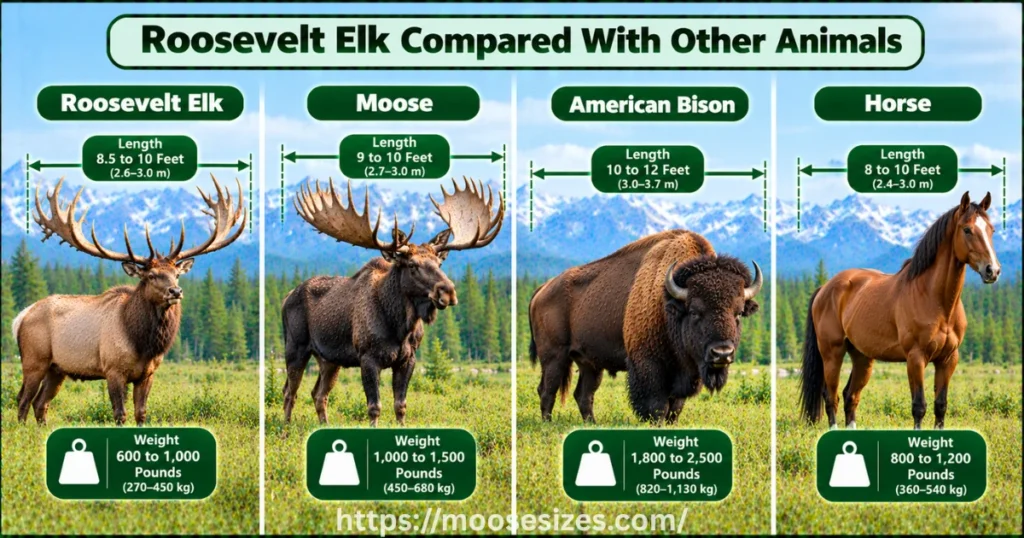
A mature Roosevelt bull can weigh 900 to 1,100 pounds and stand about 5 feet at the shoulder. A large bull moose can weigh 1,200 to 1,500 pounds and stand 6 to 6.5 feet tall at the shoulder.
Moose have longer legs, larger bodies, and broader heads. Winner: moose, which is generally heavier and taller than a Roosevelt elk.
Rocky Mountain Elk vs American Bison Size
A Rocky Mountain bull averages around 700 pounds, while a mature American bison can weigh 1,000 to 2,000 pounds or more. Bison also have massive shoulders, thick necks, and a muscular build.
Rocky Mountain elk are taller-looking and more slender, but bison usually have much greater body mass. Winner: American bison for weight and bulk.
Roosevelt Elk vs Horse Size
A Roosevelt bull weighs around 900 to 1,100 pounds, putting it within the range of many domestic horses. Large horse breeds can exceed 2,000 pounds, although smaller horses may weigh less than a mature bull elk.
Their shoulder heights can overlap, but horses vary greatly by breed. Winner: it depends on the breed; a large draft horse can outweigh a Roosevelt elk considerably.
Hi, I’m Natalie Collins, the admin at MooseSizes.com. We simplify animal sizes, measurements, and wildlife comparisons with easy-to-follow guides, useful size charts, and accurate information to help you understand animal dimensions with confidence.