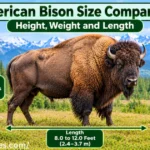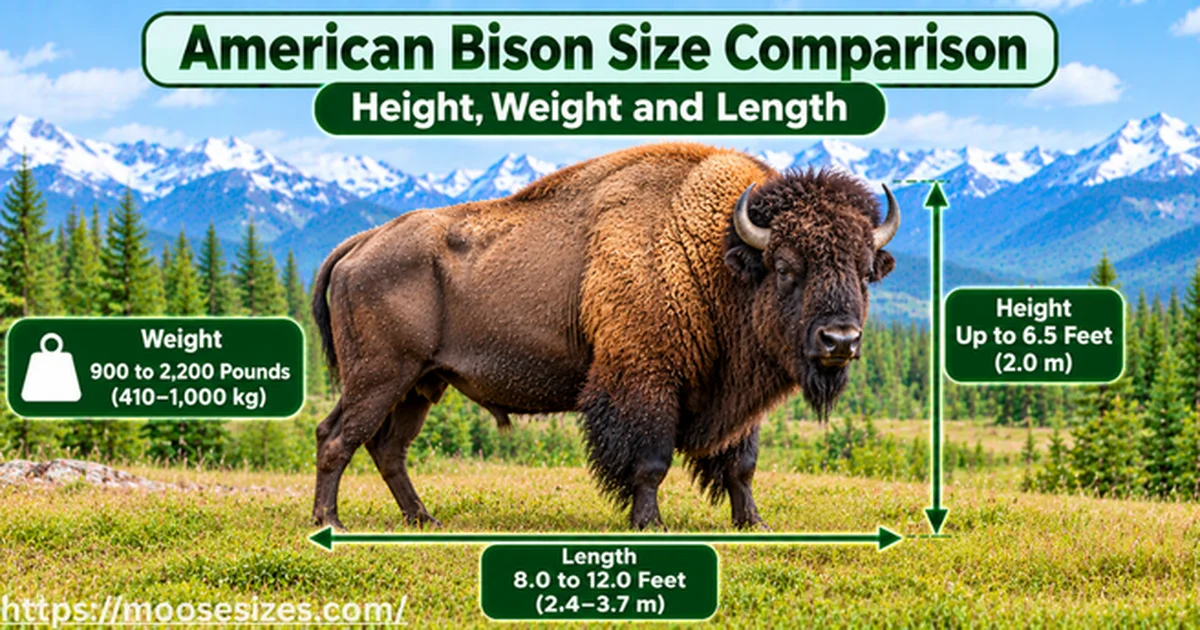
How big is an American bison? A full-grown bull stands 5.5 to 6.5 feet tall at the hump. It measures 9 to 12.5 feet long and weighs 1,800 to 2,400 pounds. That makes it the largest land mammal in North America.
This guide covers American bison size by sex, age and type. It also compares bison with moose, elk, grizzly bears, horses, cows and people.
American Bison Size Chart
| Measure | Bull | Cow |
|---|---|---|
| Height at hump | 5.5–6.5 ft (1.7–2 m) | About 5 ft (1.5 m) |
| Length | 9–12.5 ft (2.7–3.8 m) | 7–10 ft (2.2–3 m) |
| Weight | Up to 2,000+ lb | Up to about 1,000 lb |
American Bison Weight
How much does an American bison weigh? The Smithsonian’s National Zoo gives a range of 1,800 to 2,400 pounds (816 to 1,088 kg) for large adults. Other wildlife sources list 1,000 to 2,000 pounds for the species as a whole.
The numbers differ because bulls and cows differ a lot. Season, age and food supply also change the scale reading. A bison is heaviest in fall, after months of rich summer grass.
American Bison Height and Length
Bison height is measured at the hump, not the head. The hump sits over the shoulders and is solid muscle. It makes the animal look taller than it is at the hips.
The head hangs low, close to the ground. So a bison’s body length looks shorter than a moose’s, even when the weights are far apart.
More Post: Mule Deer Size
American Bison Size by Sex and Age
Bull vs Cow Size
Are male bison bigger than females? Yes. Bulls are taller, longer and about twice as heavy as cows. The U.S. Department of the Interior lists bulls up to 2,000 pounds and cows up to 1,000 pounds.
Bulls also grow a black beard about one foot long. Their front body is covered in thick, dark hair. The back half has shorter hair, so the animal looks front-heavy.
Calf Size at Birth and Growth
A newborn calf weighs only 30 to 70 pounds. Its coat is orange-red, so people call calves “red dogs.” Most are born from late March through May.
A calf can keep up with the herd within days. After a few months, its coat turns dark brown. The shoulder hump and horns then start to grow.
Cows are mature at 2 to 3 years old. Bulls reach maturity near age three but often don’t breed until about six. Bulls keep adding bulk for several years.
Largest American Bison on Record
Most wild bulls top out near 2,000 pounds. Captive bulls fed on rich feed can grow heavier, and a few reports go well past 2,500 pounds. These are rare and not typical.
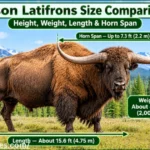
Ancient bison were far bigger. Bison latifrons, an extinct giant, had horns that spanned about 9 feet from tip to tip, based on fossil records.
More Post: Caribou Size
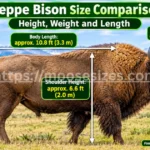
Plains Bison vs Wood Bison Size
Plains Bison Size
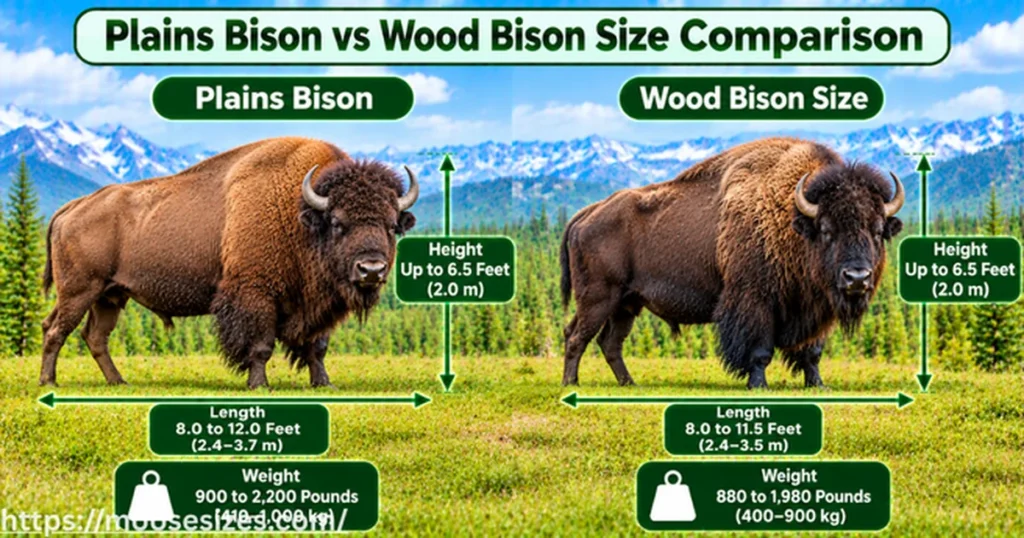
Plains bison are the animals most people picture. They live on the grasslands of the Great Plains and in parks such as Yellowstone. The size range in the first section fits this type.
Wood Bison Size
Wood bison live in the northern forests of Canada and Alaska. They are the larger of the two types. Big wood bison bulls can match or beat the biggest plains bulls.
Wood bison also have a squarer hump and darker, smoother fur. Studies of DNA show both types belong to one species, Bison bison.
American Bison vs European Bison Size
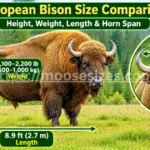
The European bison, or wisent, is the only other living bison species. It stands about as tall as its American cousin. It is a bit lighter, with longer legs and a smaller hump.
For raw bulk, the American bison wins. It is the heavier of the two.
More Post: White-Tailed Deer Size
Bison Body Size
Hump and Head Size
The hump is not fat. It is a block of muscle that powers the head. In winter, a bison swings its huge head side to side like a plow. This clears snow and uncovers grass.
The head is also the best-insulated part of the body. Bison face into blizzards, and thick hair there keeps them warm.
Horn Size
Both bulls and cows have short, hollow horns. They curve outward and then up. Bull horns are thicker and heavier.
Bulls use their horns, and their weight, to push and butt other bulls in the rut. These fights rarely end in death.
More Post: Red Deer Size
American Bison vs Other Animals Size
American Bison vs Moose
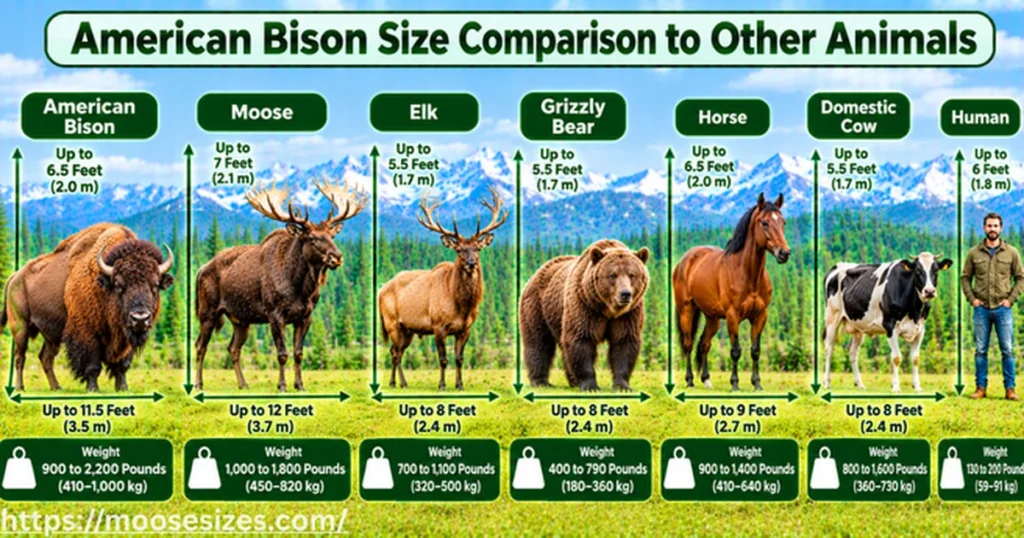
Picture a bison bull and a moose bull standing side by side on a snowy meadow. The moose is taller. It stands about 5 to 7 feet at the shoulder on long, stilt-like legs and measures 8 to 10 feet in length. A big bull moose weighs about 1,000 to 1,500 pounds.
The bison looks shorter and far wider. A bull stands 5.5 to 6.5 feet at the hump and 9 to 12.5 feet long. It weighs 1,800 to 2,400 pounds.
Is a bison bigger than a moose? Yes, in weight. The moose wins on height. The bison wins on overall bulk.
American Bison vs Elk
An elk bull is a large deer. It stands about 4.5 to 5 feet at the shoulder and runs 6.5 to 8 feet long. It weighs 600 to 750 pounds on average, and a few bulls pass 1,000 pounds.
A bison bull stands taller at the hump and is two to three times heavier. The bison wins easily.
American Bison vs Grizzly Bear
A male grizzly stands about 3.5 to 4 feet at the shoulder and is 6.5 to 8 feet long. Most weigh 400 to 790 pounds. Large coastal bears can pass 1,000 pounds.
Standing on its hind legs, a grizzly can reach 7 feet or more. On four legs, it is much lower and lighter than a bison bull. The bison wins on size.
American Bison vs Horse
A typical riding horse stands about 5 feet at the withers. It is around 8 feet long and weighs 1,000 to 1,500 pounds. Big draft horses can reach 1,800 to 2,200 pounds and stand over 6 feet.
A bison bull is close to a draft horse in weight. It is shorter at the back but far thicker through the chest and shoulders. It is a tie, with a slight edge to the bison in sheer mass.
American Bison vs Domestic Cow
Most beef and dairy cows weigh 1,000 to 1,500 pounds. They stand 4 to 4.5 feet at the shoulder. A bison cow is lighter than that, while a bison bull is much heavier.
Bison are also taller at the hump and built differently. They have a muscular front, a big head and slim hips. The bison bull wins.
American Bison vs Human
The average American man is about 5 feet 9 inches tall. He weighs close to 200 pounds, based on CDC data. A bison bull is about as tall as him at the hump.
But the bull weighs about ten times more. A bison eats about 1.6% of its body weight in dry plants each day. For a 2,000-pound bull, that is roughly 32 pounds of grass daily.
More Post: Elk vs Caribou Size
FAQ’s About American Bison Size
How tall is an American bison?
A bull stands 5.5 to 6.5 feet tall at the hump. A cow stands about 5 feet tall.
How much does a full-grown American bison weigh?
Bulls weigh about 1,800 to 2,400 pounds, and cows up to about 1,000 pounds. Wild herds often fall toward the lower end of these ranges.
Is a bison bigger than a moose?
Yes, in weight. A bison bull is heavier, while a moose bull stands taller at the shoulder.
What is the largest land animal in North America?
The American bison is the largest land mammal in North America. It was named the U.S. national mammal in 2016.
How fast can an American bison run?
Bison run at 30 to 40 miles per hour. They can also jump about six feet high.

Hi, I’m Natalie Collins, the admin at MooseSizes.com. We simplify animal sizes, measurements, and wildlife comparisons with easy-to-follow guides, useful size charts, and accurate information to help you understand animal dimensions with confidence.