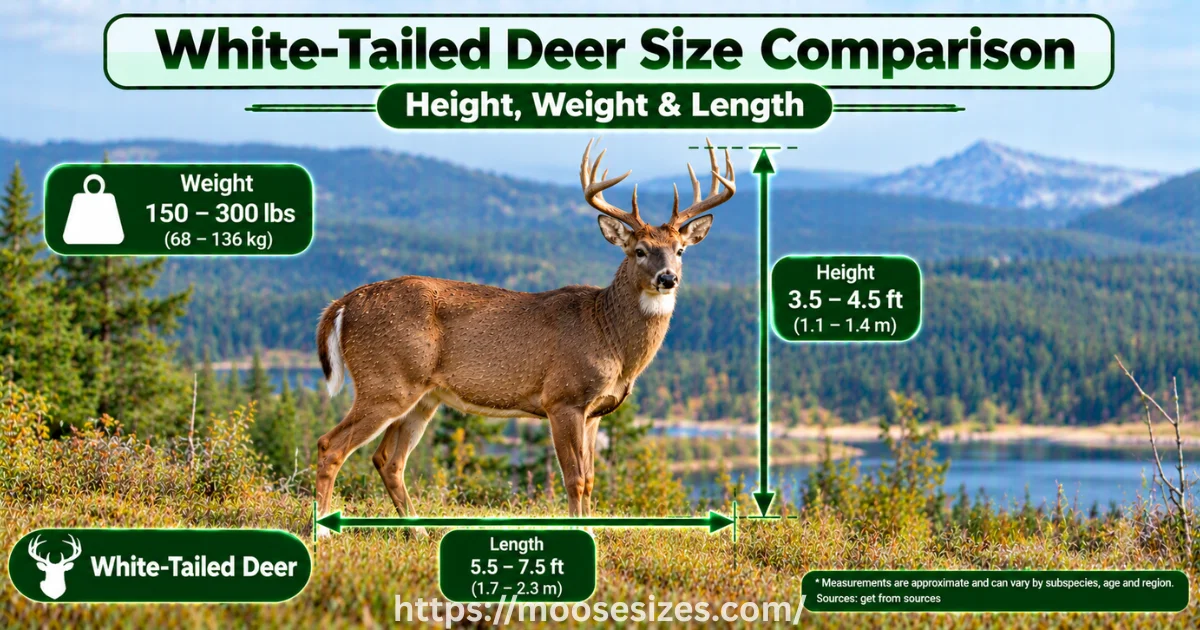
A full-grown white-tailed deer stands 3 to 3.5 feet tall at the shoulder. It measures 5 to 7 feet long and weighs 90 to 300 pounds. Bucks are bigger than does. Size also changes with region, food and age.
This guide covers white-tailed deer size by sex, region and age. It also compares the deer to a moose, an elk, a mule deer, a human and a dog.
White-Tailed Deer Size
Average White-Tailed Deer Size in the USA
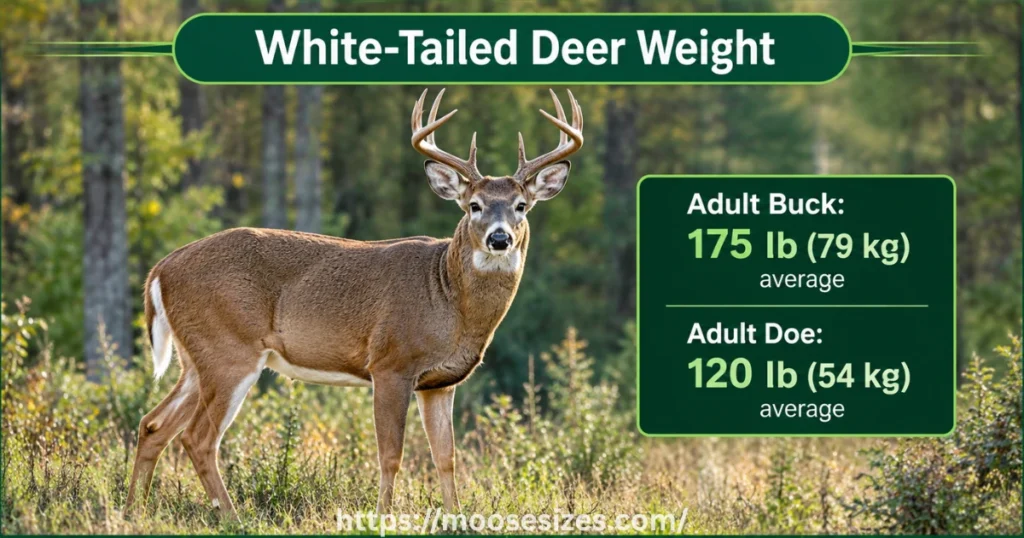
The average white-tailed deer is a mid-sized animal. Most adult bucks weigh 150 to 220 pounds. Most adult does weigh 100 to 150 pounds.
Wildlife agencies list wider ranges. Large bucks can pass 300 pounds in the northern states.
White-Tailed Deer Height at the Shoulder
How tall is a white-tailed deer? Adults stand about 36 to 42 inches at the shoulder. That is roughly 3 to 3.5 feet. The tallest bucks reach about 45 inches.
With the head up, a deer looks much taller. The antlers add even more.
White-Tailed Deer Length From Nose to Tail
How long is a white-tailed deer? Body length runs about 5 to 7 feet from nose to tail tip. The tail alone adds 6 to 13 inches.
Bucks are longer and thicker through the neck and chest. Does look slimmer and lighter.
More Post: Red Deer Size
White-Tailed Deer Weight
How Much Does a White-Tailed Buck Weigh?
How much does a white-tailed buck weigh? A mature buck usually weighs 150 to 300 pounds. A buck in the Northeast or Midwest sits near the top of that range.
A buck is at its heaviest just before the rut. During the rut he eats little and burns fat fast. He can lose 20 to 25 percent of his weight.
How Much Does a White-Tailed Doe Weigh?
How much does a white-tailed doe weigh? A mature doe usually weighs 90 to 200 pounds. Many sit between 100 and 150 pounds.
A doe also changes weight through the year. She carries her fawns for about 200 days and nurses them into summer.
Fawn Size at Birth and Growth by Age
A fawn weighs only 4 to 8 pounds at birth. Its coat is reddish-brown with white spots. The spots hide it on the forest floor.
Growth is fast. In Maryland, yearling bucks average about 105 pounds and yearling does about 90 pounds. Does reach full size around age 3. Bucks keep growing until about age 4 or 5.
Live weight vs field-dressed weight: Hunters often quote the field-dressed weight. It is the weight after the organs are removed. It runs about 20 to 25 percent lower than live weight.
More Post: Elk vs Caribou Size
White-Tailed Deer Size by Region
Northern vs Southern White-Tailed Deer Size
Deer in cold places grow bigger. Biologists call this Bergmann’s rule. A larger body holds heat better in winter.
Deer in Minnesota, Wisconsin, Michigan and Maine are the largest white-tailed deer. Deer in Florida, Georgia and Texas are smaller. Southern bucks often weigh 100 to 150 pounds.
Key Deer: The Smallest White-Tailed Deer
The Key deer is the smallest white-tailed deer in the U.S. It lives only in the Florida Keys. It stands about 26 to 32 inches at the shoulder. Bucks weigh around 80 pounds and does around 65 pounds.
It is a protected subspecies. There are more than 30 subspecies of white-tailed deer across the Americas.
Biggest White-Tailed Deer on Record
The heaviest white-tailed deer on record was a Minnesota buck from 1926. Its reported live weight was 511 pounds. That is far above normal.
For antler size, the typical world record is a Saskatchewan buck taken in 1993. It scored 213 5/8 on the Boone and Crockett scale. A non-typical Missouri buck found in 1981 scored 333 7/8.
What Affects White-Tailed Deer Size?
Four things drive deer size:
- Nutrition: Rich crops and acorns build bigger bodies.
- Genetics: Big parents tend to raise big fawns.
- Age: Older bucks carry more muscle and fat.
- Habitat and climate: Cold regions with strong food supplies produce the heaviest deer.
A deer born in poor habitat may stay small all its life. A deer fed well as a fawn grows faster and larger.
More Post: Elk vs Red Stag Size
White-Tailed Deer Antler Size
Antler Size by Age and Nutrition
Only bucks grow antlers. They shed them every winter and regrow them in spring. Growth can reach half an inch per day. Antler tissue is among the fastest-growing in nature.
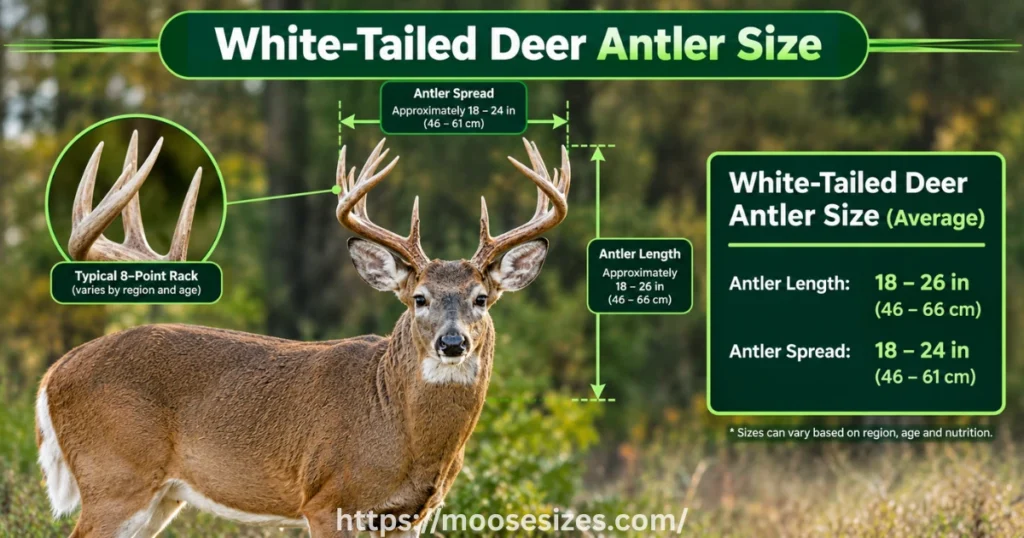
A young buck may grow spikes or a few points. By age 3, many bucks have about 8 points. Antlers do not show a deer’s exact age. Food and genetics decide antler size. Biologists read tooth wear to estimate age.
Antler Spread, Points and Weight
A typical rack weighs 3 to 9 pounds. Mature bucks often have 8 to 12 points and an inside spread of 14 to 20 inches. The main beam curves forward. Smaller tines rise from it.
Antlers are bone. They are covered in velvet while they grow. The buck rubs it off in early fall.
White-Tailed Deer Size vs Other Animals
White-Tailed Deer vs Moose Size
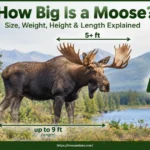
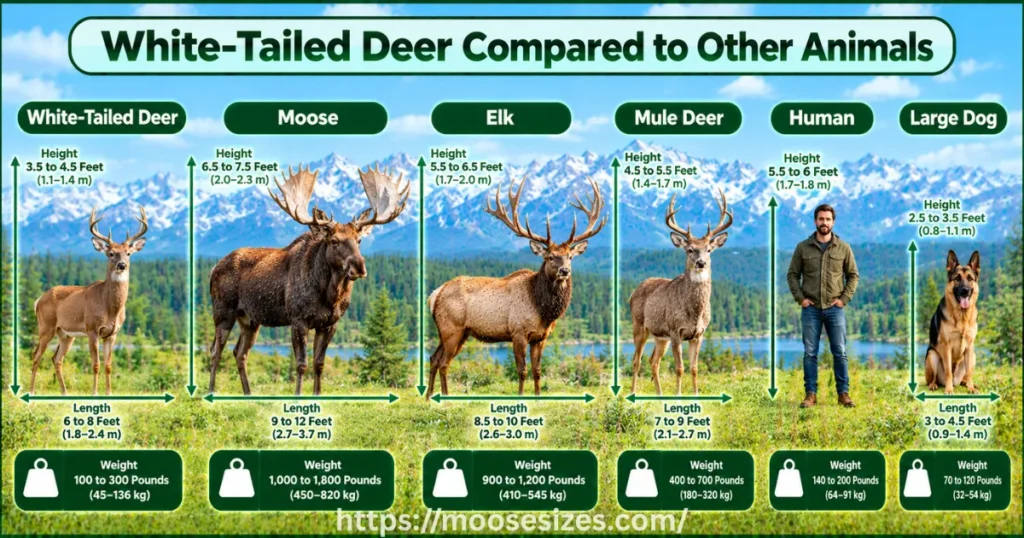
A moose is far bigger. A bull moose weighs 800 to 1,500 pounds and stands 5 to 6.5 feet at the shoulder. It measures 8 to 10 feet long. A big whitetail buck weighs 150 to 300 pounds, stands 3 to 3.5 feet and runs 5 to 7 feet long.
Picture a deer walking under a moose’s belly. A moose can weigh five times as much as a large buck. The moose wins by a wide margin.
White-Tailed Deer vs Elk Size
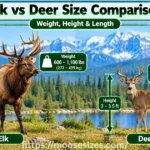
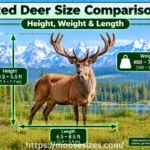
An elk sits between the two. A bull elk weighs 600 to 800 pounds. It stands 4.5 to 5 feet at the shoulder and measures 6 to 9 feet long.
A whitetail buck is about one-third the weight of a bull elk. The elk also has a thicker neck and much longer antlers. The elk wins.
White-Tailed Deer vs Mule Deer Size
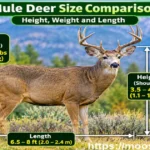
These two deer are close in size. A mule deer buck weighs 150 to 300 pounds. A doe weighs 95 to 200 pounds. Both stand about 3 to 3.5 feet tall.
A mule deer is usually a bit stockier. Its ears are much bigger, and its antlers fork instead of branching from one beam. On average, the mule deer edges ahead.
White-Tailed Deer vs Human Size
An adult American man stands about 5 feet 9 inches and weighs around 200 pounds. A deer’s back reaches roughly your waist or hip. With its head raised, it comes near chest height.
A large buck can match a man in weight. It is shorter, but it is far faster. A whitetail can run 30 to 36 miles per hour and leap about 8 feet high.
White-Tailed Deer vs Large Dog Size
A Great Dane stands 28 to 32 inches tall and weighs 110 to 175 pounds. A whitetail buck stands taller and is often heavier. A typical doe is close to a Great Dane in weight.
The deer has longer legs and a longer neck. A big buck usually wins on size.
More Post: American Elk Size
FAQ’s White-Tailed Deer Size
How big is a full-grown white-tailed deer?
A full-grown white-tailed deer stands 3 to 3.5 feet at the shoulder and measures 5 to 7 feet long. It weighs 90 to 300 pounds, with bucks heavier than does.
How tall is a white-tailed deer?
An adult white-tailed deer is about 36 to 42 inches tall at the shoulder. Large bucks can reach about 45 inches.
How much does an average white-tailed deer weigh?
The average buck weighs about 150 to 220 pounds. The average doe weighs about 100 to 150 pounds. Northern deer weigh more than southern deer.
What is the biggest white-tailed deer ever recorded?
The heaviest on record was a 1926 Minnesota buck with a reported live weight of 511 pounds. The typical antler record is 213 5/8 Boone and Crockett points.
Are white-tailed deer bigger than mule deer?
No, mule deer are usually a little bigger and stockier. Both have similar shoulder heights. Mule deer also have larger ears and forked antlers.

Hi, I’m Natalie Collins, the admin at MooseSizes.com. We simplify animal sizes, measurements, and wildlife comparisons with easy-to-follow guides, useful size charts, and accurate information to help you understand animal dimensions with confidence.