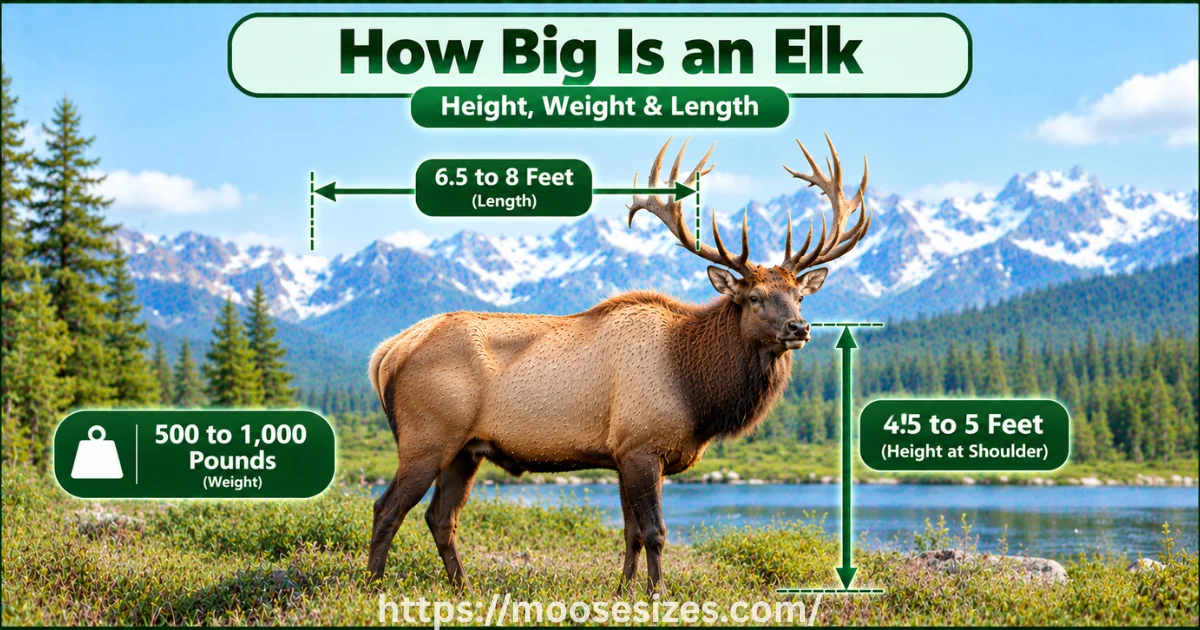
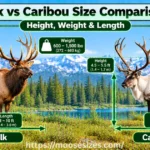
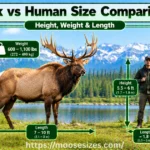
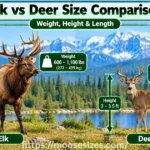
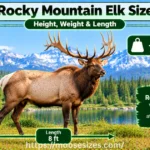
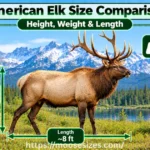
An adult elk stands 4.5 to 5 feet tall at the shoulder and measures 6.5 to 8 feet long. It weighs 500 to 1,000 pounds, and bulls run heavier than cows.
That makes the elk, also called the wapiti, the second-largest deer in North America, behind the moose. This guide covers elk size by sex, age and region, plus antlers, the kill zone and how an elk stacks up against other animals.
Average Elk Size
Measure
Cow
Bull
Shoulder height
about 4.5 ft
5 ft or more
Body length
about 6.5 ft
7 to 8 ft
Weight
500 to 650 lb
600 to 900+ lb
Elk Size by Subspecies
Not all elk are the same size. The Roosevelt elk of the Pacific Northwest has the biggest body. The Rocky Mountain elk has the largest antlers. The Tule elk of California is the smallest, with bulls often near 400 to 550 pounds.
Elk Size at Birth and by Age
A newborn elk calf weighs about 30 to 40 pounds. It is born with white spots that help it hide in tall grass.
Calves grow fast. Bulls keep adding mass until about age 5 or 6. Antler size peaks later, often between ages 7 and 9.
A woman of average height (5 ft 4 in) would stand eye to eye with an elk’s shoulder. Add the neck, head and antlers, and a bull can reach 8 to 9 feet tall. On weight, one bull equals about four to six adults.
Bull Elk Size
Bull Elk Height, Weight and Length
A mature bull elk stands about 5 feet at the shoulder and stretches 7 to 8 feet from nose to tail. Most weigh 600 to 900 pounds. Big Roosevelt bulls can top 1,000 pounds, and some reach about 1,200.
Bulls also have a thick neck mane and a heavy chest. This gives them a powerful, front-heavy look.
Bull Elk Size by Season
A bull’s weight is not fixed. He is heaviest in late summer, before the rut. During the fall breeding season he eats little and fights a lot. A bull can lose up to about 20 percent of his body weight. This matters if you judge size by the scale in October.
Largest Bull Elk
The largest bulls come from the Roosevelt subspecies. Wet coastal forests give them steady food and let them grow big. Rocky Mountain bulls are lighter but carry the longest antlers.
A cow elk stands about 4.5 feet at the shoulder and measures roughly 6.5 feet long. Most weigh 500 to 650 pounds. Some large cows reach 700 or more.
Cows are lean and rangy. They have no antlers and a lighter neck.
Bull vs Cow Elk Size Difference
A bull is about 100 to 250 pounds heavier than a cow, and a few inches taller. The easiest way to tell them apart is the head. Bulls carry antlers from spring to late winter. Cows never do.
Out of antler season, look at the neck. A bull’s is thick and dark. A cow’s is slim.
Elk Calf Size
A calf starts near 35 pounds. By its first fall it has grown many times over. Young elk lose their spots by late summer and start to look like small cows.
Elk Antler Size
elk-antler-size
Average Elk Antler Size
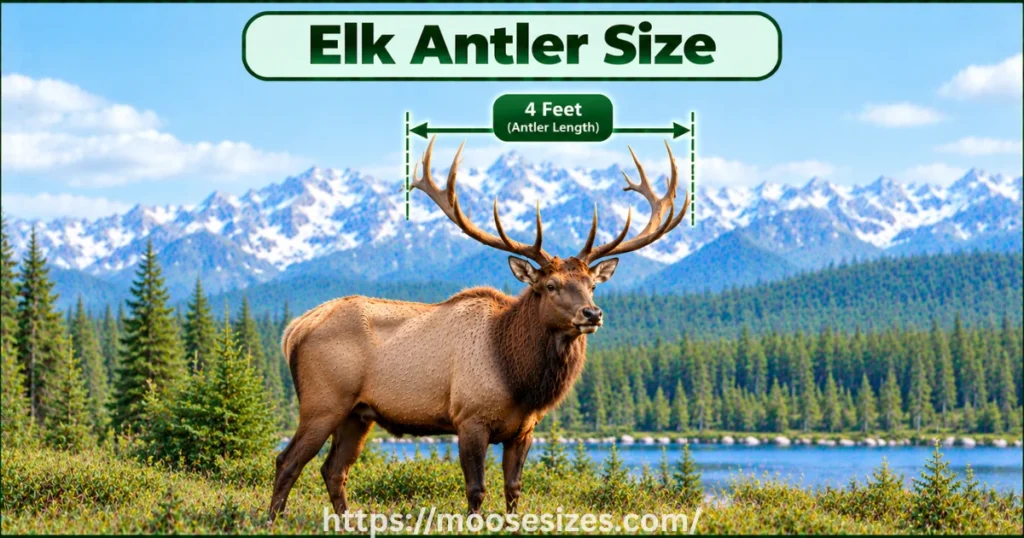
Only bull elk grow antlers. A mature set spreads about 4 feet wide, and each main beam can reach 4 feet or more in length. A full set can weigh up to about 40 pounds.
That is a heavy crown to carry on the neck for months.
Elk Antler Growth and Shedding
Elk antlers are among the fastest-growing tissues in mammals. They can grow about an inch a day in summer. During growth they are covered in soft velvet, which is full of blood vessels.
By late summer the velvet dries and the bull rubs it off. Bulls shed their antlers in late winter or early spring. New ones start growing within weeks.
Elk Antler Points and Score
Hunters count tines, the points on each side. A 6×6 bull, also called a royal, has six on each antler. Older bulls often grow bigger, heavier racks with more points.
To measure a rack, hunters use the Boone and Crockett scoring system. Rocky Mountain elk have the largest antlers of the subspecies.
The elk kill zone is the heart and lung area. On a mature elk seen from the side, it is commonly described as about 10 to 12 inches across. Think of a large dinner plate.
A deer’s vital zone is smaller, so shot placement is a bit more forgiving on an elk.
Where the Elk Kill Zone Is Located
On a broadside elk, aim just behind the front shoulder, about a third of the way up from the belly. This is where the lungs and heart sit.
Always check your state’s rules and take shots only within your skill and range.
Elk Kill Zone vs Deer Kill Zone
An elk is far bigger than a whitetail, so everything scales up. The vital area is larger, but bone and muscle are thicker. That means a shot needs enough energy and penetration.
Elk will not drop easily if the hit is poor. Good placement matters more than raw power.
Elk vs Moose and Other Animals Size
elk-vs-moose-vs-deer-vs-horse
Elk vs Moose Size
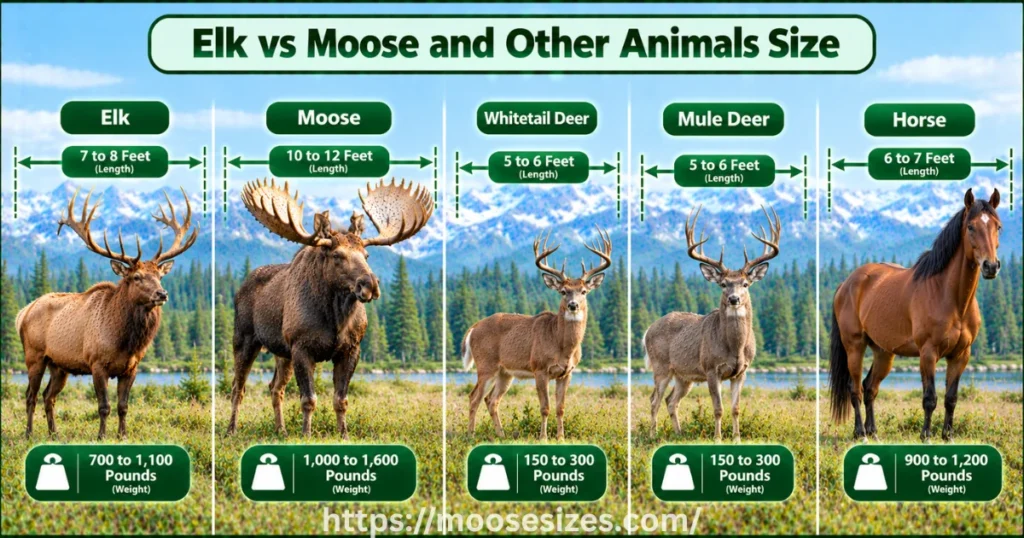
Next to a moose, even a big bull elk looks smaller. A bull moose stands 5 to 6.5 feet at the shoulder. He is 8 to 10 feet long and often weighs 800 to 1,500 pounds. A bull elk is 5 feet tall, about 8 feet long and 600 to 900 pounds.
The moose has longer legs and a heavy hump over his shoulders. His antlers are wide and flat. The elk are tall and branching. Winner: the moose. An elk is about two-thirds a moose’s size.
Elk vs Whitetail Deer Size
A whitetail deer looks small beside an elk. A buck stands about 3 to 3.5 feet tall, runs 5 to 6.5 feet long and weighs about 150 to 300 pounds.
An elk is about three times larger. Many deer would be needed to balance the scale against one bull. Winner: the elk.
Elk vs Mule Deer Size
A mule deer buck is a bit stockier than a whitetail. He stands about 3 to 3.5 feet at the shoulder and weighs roughly 150 to 300 pounds. His ears are large, and he has forked antlers.
Even so, an elk still dwarfs him in height, length and weight. Winner: the elk.
Elk vs Horse Size
A horse is the closest everyday animal to an elk. Many horses stand 4.8 to 5.7 feet at the shoulder, and they are about 8 feet long, like a big bull. An average horse weighs about 900 pounds, close to a bull elk.
Some draft horses are far heavier. Horses have no antlers, but an elk has a longer reach with its rack. Winner: a tie.
Hi, I’m Natalie Collins, the admin at MooseSizes.com. We simplify animal sizes, measurements, and wildlife comparisons with easy-to-follow guides, useful size charts, and accurate information to help you understand animal dimensions with confidence.